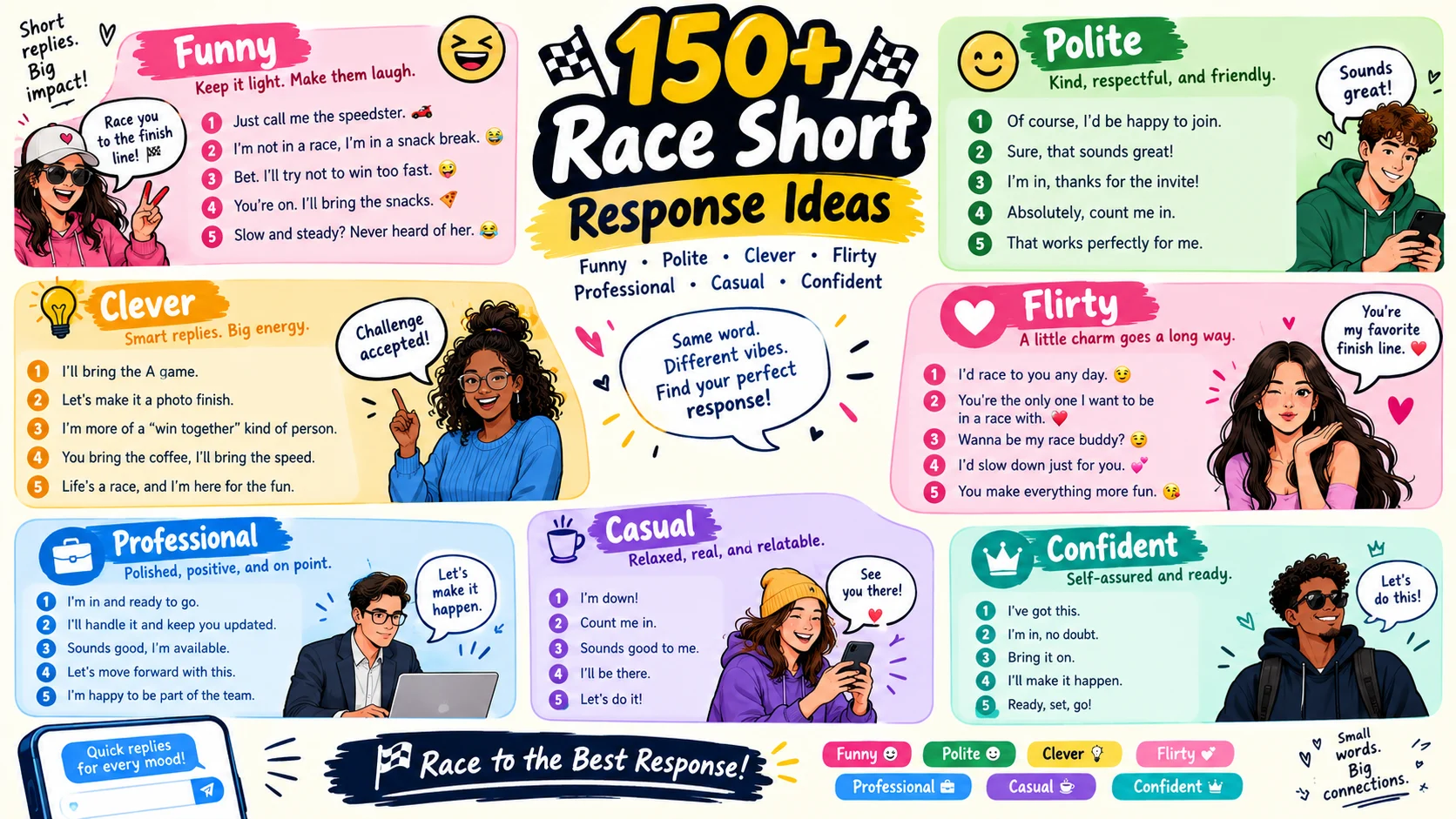
A short response is a brief, natural reply you can use when someone asks about your race or brings up race in a conversation. The best response depends on your comfort level, relationship, and the situation.
Top alternatives: I’m [race/ethnicity], I’d rather not say, What makes you ask?, I’m mixed, I’m happy to share
Ever get a message that makes you pause for three seconds before typing anything? “What’s your race?” is one of those questions. It can pop up in texts, DMs, dating apps, workplace conversations, school chats, or random social media comments. Sometimes the person is genuinely curious. Other times, the timing is awkward enough to make you wonder if your keyboard needs a vacation.
Knowing a good race’s short response can make these moments much easier. You can answer directly, keep things private, add a little humor, or politely move the conversation along. The right reply depends on your comfort level and the relationship you have with the person asking.
Below, you’ll find short responses organized by personality and situation, so you can pick something that actually sounds like you.
Funny Responses
- My race? Apparently, the human race.
Use this when you want to give a playful answer without getting too serious.
Meaning: It uses humor to keep the question light. - Fast enough to the food table.
Use this with close friends who appreciate goofy humor.
Meaning: It deliberately dodges the serious meaning of the question. - I’m currently winning the race to mind my business.
Use this when someone asks too casually.
Meaning: You are jokingly signaling that the question is personal. - Team human, obviously.
Use this for a quick social media reply.
Meaning: You are giving a playful, universal answer. - Race cards declined. Try again later.
Use this when you want a meme-style response.
Meaning: You are humorously refusing to provide personal information. - I came here for vibes, not paperwork.
Use this when the conversation suddenly becomes overly personal.
Meaning: You want to keep things casual. - Plot twist: I’m a little bit of everything.
Use this when your background is mixed or diverse.
Meaning: You are playfully describing a mixed identity. - My ancestry report would need a spreadsheet.
Use this when your background is complicated.
Meaning: Your heritage has multiple parts that are difficult to summarize. - Long story, excellent snacks.
Use this when you want to tease before explaining.
Meaning: Your background has an interesting story behind it. - That answer comes with a family tree.
Use this when your heritage is diverse.
Meaning: A simple answer would not capture your background. - Human, with bonus features.
Use this with friends who enjoy playful replies.
Meaning: You are turning the question into harmless humor. - Let’s just say the family group chat is international.
Use this when your family has diverse roots.
Meaning: Your family background includes different cultures or origins.
Brutal Responses
- Why do you need to know?
Use this when the question feels unnecessarily personal.
Meaning: You are asking the person to explain their reason. - That’s a pretty personal question.
Use this when you want to establish a clear boundary.
Meaning: You are signaling that you may not want to answer. - What makes you curious?
Use this when you want the other person to clarify their intentions.
Meaning: You are redirecting the question back to them. - Do you ask everyone that?
Use this when the question feels unusual or intrusive.
Meaning: You are challenging the assumption behind the question. - Interesting question for a first conversation.
Use this when someone asks it too early.
Meaning: You are pointing out that the timing feels unexpected. - That information isn’t exactly public.
Use this when you prefer privacy.
Meaning: You are making it clear that the information is yours to share. - You skipped right past “How are you?”
Use this with someone who jumps straight into personal questions.
Meaning: You are humorously calling attention to their approach. - That’s not something I usually discuss.
Use this when you want a firm but calm boundary.
Meaning: You are declining without creating unnecessary conflict. - You can be curious without being entitled to an answer.
Use this when someone keeps pushing.
Meaning: You are clearly defending your privacy. - I’ll keep that one mysterious.
Use this when you want a softer refusal.
Meaning: You are declining while keeping the mood relaxed. - That question needs a little more context.
Use this when you are unsure why they are asking.
Meaning: You want clarification before answering. - I decide what personal details I share.
Use this when you need a direct boundary.
Meaning: You are asserting control over your own information.
Flirty Responses
- Are you curious about my race or just curious about me?
Use this when there is obvious romantic chemistry.
Meaning: You are turning the question into playful flirting. - You’re asking a lot of questions for someone trying to impress me.
Use this when teasing a crush.
Meaning: You are playfully suggesting romantic interest. - Maybe I’ll tell you over coffee.
Use this when you want to turn the conversation into a date opportunity.
Meaning: You are responding warmly while suggesting more time together. - You’ll have to get to know me first.
Use this when you want to keep some mystery.
Meaning: You are encouraging a deeper connection before personal details. - Curious already? I like that.
Use this when the conversation feels playful.
Meaning: You are welcoming their interest. - That’s one question on the getting-to-know-me list.
Use this when you want to continue the conversation.
Meaning: You are framing the question as part of getting closer. - I could tell you, but where’s the fun in that?
Use this when you enjoy playful mystery.
Meaning: You are teasing instead of answering immediately. - First tell me why you’re curious.
Use this when you want to flirt while learning their intentions.
Meaning: You are inviting them to reveal their interest. - You’re definitely curious about me.
Use this when you want to tease someone.
Meaning: You are highlighting their attention toward you. - That answer might require a second date.
Use this when you already have a romantic connection.
Meaning: You are playfully creating an excuse to meet again. - Ask nicely and maybe.
Use this for a light, teasing reply.
Meaning: You are keeping the answer playful and open-ended. - You’re cute when you’re curious.
Use this when the relationship supports affectionate teasing.
Meaning: You are turning curiosity into a compliment.
Polite Responses
- I’m [race or ethnicity].
Use this when you are comfortable answering directly.
Meaning: You are providing a straightforward response. - I’m mixed.
Use this when you have a mixed racial or ethnic background.
Meaning: You are giving a concise description of your background. - I’m happy to share that.
Use this when the question feels respectful.
Meaning: You are willingly offering personal information. - I’m [background], if you’re asking about ethnicity.
Use this when race and ethnicity may be getting mixed together.
Meaning: You are clarifying what type of identity information you are sharing. - I usually describe myself as [identity].
Use this when you prefer a particular identity label.
Meaning: You are explaining how you personally identify. - I’m comfortable saying I’m [identity].
Use this when you want to answer while emphasizing personal choice.
Meaning: You are sharing information on your own terms. - I’d rather keep that private, but thanks for asking respectfully.
Use this when someone asks politely but you do not want to answer.
Meaning: You are setting a boundary without being hostile. - I don’t usually discuss that.
Use this when you prefer not to share.
Meaning: You are politely declining. - My background is pretty diverse.
Use this when a simple label does not feel accurate.
Meaning: You are acknowledging diversity without giving specific details. - There are a few parts to my background.
Use this when your heritage is complex.
Meaning: You are indicating that your identity has multiple influences. - I identify as [identity].
Use this when you want to state your preferred description.
Meaning: You are clearly communicating your own identity. - I appreciate you asking respectfully.
Use this when the question is asked thoughtfully.
Meaning: You are acknowledging the person’s respectful approach.
Professional Responses
- I prefer to keep personal background separate from work.
Use this when a workplace conversation becomes too personal.
Meaning: You are maintaining a professional boundary. - I generally keep demographic information private.
Use this when you want a formal response.
Meaning: You are declining without unnecessary detail. - I’d rather focus on the project.
Use this when you want to redirect a work conversation.
Meaning: You are bringing attention back to the professional topic. - I’m not sure that information is relevant here.
Use this when the question has no clear connection to the discussion.
Meaning: You are questioning its relevance. - I prefer not to discuss personal demographics at work.
Use this when you want a direct workplace boundary.
Meaning: You are clearly separating personal identity from professional communication. - I keep that information private.
Use this when you want a concise formal answer.
Meaning: You are politely refusing to disclose it. - Let’s keep the conversation work-related.
Use this when you want to redirect the discussion.
Meaning: You are establishing professional boundaries. - I’m happy to discuss my qualifications instead.
Use this when personal questions appear in a professional context.
Meaning: You are redirecting toward relevant professional information. - I’d prefer to discuss that in a personal setting, if necessary.
Use this when context genuinely matters.
Meaning: You are asking for a more appropriate setting. - That’s personal information, so I’ll keep it private.
Use this when you want to be clear and respectful.
Meaning: You are declining without confrontation. - I appreciate your curiosity, but I keep that private.
Use this when you want a courteous professional tone.
Meaning: You are acknowledging the question while maintaining a boundary. - I don’t think that’s relevant to our discussion.
Use this when the question distracts from the topic.
Meaning: You are calmly redirecting the conversation.
Creative Responses
- My background is a whole playlist, not one song.
Use this when your heritage has multiple influences.
Meaning: You are describing a diverse identity creatively. - A little history, a lot of family stories.
Use this when you want to answer warmly.
Meaning: You are emphasizing personal heritage and family history. - My family tree has some interesting branches.
Use this when your background is diverse.
Meaning: Your heritage has several distinct influences. - I’m a blend of different chapters.
Use this when you want a thoughtful response.
Meaning: You are describing identity as something layered. - My roots have more than one direction.
Use this when your ancestry is mixed.
Meaning: Your background connects to multiple places or cultures. - My heritage deserves more than one word.
Use this when a single label feels limiting.
Meaning: You believe your identity is more complex than one category. - Think of it as a cultural mixtape.
Use this when you want a modern metaphor.
Meaning: Your background includes multiple cultural influences. - There’s a whole family story behind that.
Use this when you are open to explaining more.
Meaning: Your identity connects to a larger personal history. - My roots are layered.
Use this when you want something short and meaningful.
Meaning: Your background contains multiple influences. - It’s complicated in the most interesting way.
Use this when your heritage is difficult to summarize.
Meaning: Your identity has several meaningful parts. - My family tree has entered the group project.
Use this when you want playful creativity.
Meaning: Several backgrounds contribute to your identity. - One label could never tell the whole story.
Use this when you want a thoughtful answer.
Meaning: You see identity as more complex than a category.
Sarcastic Responses
- Is this a pop quiz?
Use this when the question comes unexpectedly.
Meaning: You are joking about being put on the spot. - Did I miss the questionnaire?
Use this when someone asks abruptly.
Meaning: You are humorously questioning the situation. - That escalated quickly.
Use this when the conversation suddenly becomes personal.
Meaning: You are pointing out the unexpected shift. - Straight to the demographic questions, huh?
Use this when someone skips casual conversation.
Meaning: You are teasing them about the direct question. - Bold question for a stranger.
Use this when someone you barely know asks.
Meaning: You are signaling that the question feels personal. - We skipped several conversation levels.
Use this when the person gets personal too quickly.
Meaning: You think the question came too soon. - That’s one way to start a conversation.
Use this when the timing feels awkward.
Meaning: You are lightly calling attention to the unusual opener. - Interesting choice of icebreaker.
Use this when someone asks immediately.
Meaning: You are playfully questioning their conversational strategy. - Well, we got personal fast.
Use this when the conversation changes suddenly.
Meaning: You are acknowledging the unexpected personal question. - You really went straight for it.
Use this when someone asks very directly.
Meaning: You are teasing them for being unusually straightforward. - No warm-up round?
Use this when the question comes out of nowhere.
Meaning: You are joking that they skipped casual conversation. - That’s certainly a question.
Use this when you want a dry, understated response.
Meaning: You are signaling that you find the question notable.
Cute Responses
- I’m a little mix of everything.
Use this when you want a warm answer about a diverse background.
Meaning: You are describing your identity gently. - My roots are pretty special to me.
Use this when heritage is meaningful to you.
Meaning: You value your background personally. - I’m proud of where I come from.
Use this when you want a positive response.
Meaning: You are expressing appreciation for your heritage. - My family background is pretty interesting.
Use this when you are open to sharing more.
Meaning: You are inviting friendly curiosity. - I’ve got a fun mix of roots.
Use this when you have diverse ancestry.
Meaning: You are presenting your background positively. - There’s a sweet little family story behind it.
Use this when your heritage has personal significance.
Meaning: You are making the topic feel warm and personal. - My roots are one of my favorite things about me.
Use this when identity is important to you.
Meaning: You are expressing pride in your background. - It’s a pretty cool family mix.
Use this when you want a relaxed answer.
Meaning: You appreciate the diversity in your heritage. - I’m happy to tell you about it.
Use this when someone asks respectfully.
Meaning: You are welcoming the conversation. - There’s more to my background than one label.
Use this when your identity is layered.
Meaning: You are gently explaining that one category is limited. - My roots are part of my story.
Use this when you want something meaningful but short.
Meaning: You see heritage as part of your personal identity. - I’m proud of my family history.
Use this when discussing heritage positively.
Meaning: You are expressing appreciation for your roots.
Dramatic Responses
- Ah, the ancestry question has arrived.
Use this when you want to make the moment playful.
Meaning: You are theatrically acknowledging the question. - Prepare yourself for the family tree.
Use this when your background is complicated.
Meaning: Your heritage requires more explanation. - That answer has chapters.
Use this when your background is difficult to summarize.
Meaning: Your identity has several layers. - The family history is about to get interesting.
Use this when you are comfortable sharing your background.
Meaning: You are suggesting there is a story behind your identity. - You have unlocked the ancestry storyline.
Use this with friends who enjoy gaming references.
Meaning: You are jokingly presenting your heritage as a story arc. - This question deserves a documentary.
Use this when your background is especially complex.
Meaning: There is far too much history for a one-line answer. - Welcome to the family tree saga.
Use this when you want a theatrical reply.
Meaning: You are playfully introducing a complicated family history. - The lore goes deep.
Use this when your heritage has an interesting story.
Meaning: There is substantial background behind your identity. - You just opened a very long chapter.
Use this when you are willing to explain.
Meaning: Your background cannot be summarized quickly. - That question comes with historical footnotes.
Use this when your ancestry is complicated.
Meaning: Your heritage has many details. - The family archives are extensive.
Use this when you want dramatic humor.
Meaning: There is a lot of family history behind the answer. - This is where the plot gets complicated.
Use this when your background has several layers.
Meaning: Your identity story is not simple.
Chill And Casual Responses
- I’m [race or ethnicity].
Use this when you want the simplest possible answer.
Meaning: You are answering directly without extra explanation. - I’m mixed.
Use this when you have a mixed background.
Meaning: You are giving a concise description. - A mix, honestly.
Use this when your heritage includes multiple backgrounds.
Meaning: You are keeping the answer relaxed. - I’ve got a pretty diverse background.
Use this when several backgrounds influence your identity.
Meaning: You are giving a broad description. - There are a few different roots there.
Use this when your background is mixed.
Meaning: Your heritage comes from multiple sources. - It’s a bit of a blend.
Use this when you want a casual answer.
Meaning: Your background combines different identities. - I’m comfortable saying I’m [identity].
Use this when you want a relaxed but clear answer.
Meaning: You are sharing your preferred identity label. - That’s a longer story, but I’m mixed.
Use this when you want to answer without explaining everything.
Meaning: You are giving the essential information while keeping it brief. - My background is pretty varied.
Use this when a simple label does not fully describe you.
Meaning: Your heritage includes multiple influences. - I’m happy to explain if you’re curious.
Use this when the question seems respectful.
Meaning: You are open to a deeper conversation. - It depends whether you mean race or ethnicity.
Use this when the terms may be getting confused.
Meaning: You want to clarify exactly what the person means. - I usually just say [identity].
Use this when you have a preferred simple description.
Meaning: You are explaining the label you commonly use.
Confident Responses
- I’m proud of my background.
Use this when you want to answer positively.
Meaning: You are expressing confidence in your identity. - I know exactly where I come from.
Use this when you want a strong response.
Meaning: You are emphasizing connection to your roots. - My background is part of who I am.
Use this when identity is meaningful to you.
Meaning: You recognize heritage as part of your personal story. - I define my identity for myself.
Use this when someone seems to be labeling you.
Meaning: You are asserting personal control over identity. - I’m comfortable with who I am.
Use this when you want a confident but calm reply.
Meaning: You are expressing self-assurance. - My identity doesn’t need an explanation.
Use this when you do not want to justify yourself.
Meaning: You are setting a confident boundary. - I’m proud of all the roots that make me who I am.
Use this when you have a diverse background.
Meaning: You value every part of your heritage. - One label doesn’t define me.
Use this when someone expects a simple category.
Meaning: You believe identity is broader than one classification. - I’m comfortable sharing that when the context is right.
Use this when you want control over personal information.
Meaning: You choose when and where to discuss identity. - That’s part of my story, not my entire story.
Use this when you want to add perspective.
Meaning: Race is one aspect of identity rather than the whole person. - I’m proud of my roots and where I’m going.
Use this when you want an uplifting response.
Meaning: You value both heritage and personal growth. - I know who I am.
Use this when you want an especially concise answer.
Meaning: You are expressing strong self-confidence.
Emotional Responses
- My background means a lot to me.
Use this when heritage has deep personal meaning.
Meaning: You are expressing emotional connection to your roots. - It’s a big part of my family story.
Use this when discussing ancestry with someone you trust.
Meaning: Your identity connects closely with family history. - I’m proud of where my family comes from.
Use this when heritage is a source of pride.
Meaning: You appreciate your family’s origins. - My roots are something I value deeply.
Use this when you want a sincere response.
Meaning: You place meaningful personal value on heritage. - There’s a lot of history behind that answer.
Use this when the topic carries emotional weight.
Meaning: Your background involves meaningful family history. - My identity has been shaped by many things.
Use this when you want to provide broader context.
Meaning: You see identity as multidimensional. - I’ve learned to appreciate every part of my background.
Use this when reflecting on personal identity.
Meaning: You have developed appreciation for your heritage. - It’s something I’ve grown to understand more over time.
Use this when identity has evolved in your understanding.
Meaning: Your relationship with heritage has developed gradually. - My family history is important to me.
Use this when discussing ancestry sincerely.
Meaning: You value your family’s story. - There are parts of my background I’m still discovering.
Use this when your heritage is not completely known.
Meaning: Your understanding of your roots is still developing. - My roots connect me to people and stories I care about.
Use this when heritage is connected to family relationships.
Meaning: Your background has emotional and relational importance. - It’s more than a label to me.
Use this when identity carries personal significance.
Meaning: You view your heritage as deeper than a category.
Sweet Responses
- I’m happy to share if you’re genuinely curious.
Use this when someone asks respectfully.
Meaning: You are welcoming sincere interest. - I love talking about my roots with people I trust.
Use this when the conversation feels comfortable.
Meaning: You connect heritage with meaningful relationships. - My background is a pretty special part of me.
Use this when you want a warm answer.
Meaning: You value your heritage personally. - I’m proud of where my family comes from.
Use this when discussing heritage positively.
Meaning: You feel appreciation for your family’s origins. - I’d be happy to tell you the story.
Use this when your background has an interesting history.
Meaning: You are inviting a deeper conversation. - There’s a lot I love about my heritage.
Use this when you want to express appreciation.
Meaning: You value the cultural parts of your identity. - My roots are definitely worth knowing.
Use this when you want to continue the conversation.
Meaning: You see your background as meaningful and interesting. - I’m grateful for all the cultures that shaped me.
Use this when you have a multicultural background.
Meaning: You appreciate the influences that shaped your identity. - My family gave me a pretty interesting mix.
Use this when your background is diverse.
Meaning: You are describing your heritage warmly. - It’s one of those things that makes me, me.
Use this when you want something personal and casual.
Meaning: Your background is part of your individuality. - I’m proud to carry my family’s story with me.
Use this when heritage is deeply meaningful.
Meaning: You feel connected to previous generations. - I appreciate you being curious respectfully.
Use this when someone approaches the topic thoughtfully.
Meaning: You value respectful curiosity.
Clever Responses
- Do you mean race, ethnicity, or ancestry?
Use this when you want to make the question more precise.
Meaning: You are distinguishing between related but different concepts. - That depends on what you mean by race.
Use this when the question needs clarification.
Meaning: You recognize that the term can be interpreted differently. - I usually describe myself as [identity].
Use this when you have a preferred identity label.
Meaning: You are choosing the terminology that fits you. - My background has several layers.
Use this when one category does not capture your heritage.
Meaning: Your identity includes multiple influences. - A label gives you the headline, not the whole story.
Use this when you want a thoughtful response.
Meaning: Identity cannot always be summarized by one category. - There’s a difference between where my family comes from and how I identify.
Use this when discussing ancestry and identity.
Meaning: You are separating family origins from personal identification. - My ancestry is more detailed than my introduction.
Use this when you want a clever but sincere response.
Meaning: Your heritage contains more detail than a quick label. - I can give you the short version or the family-tree version.
Use this when you are comfortable discussing your background.
Meaning: You are offering different levels of detail. - That’s easier to answer with context.
Use this when the question feels too broad.
Meaning: You need more information before giving a precise answer. - My identity has a few footnotes.
Use this when your background is complex.
Meaning: Your heritage has details that need explanation. - The simple answer is [identity]. The longer answer has history.
Use this when you want to answer while acknowledging complexity.
Meaning: You can provide both a concise label and deeper context. - Identity is rarely as simple as a checkbox.
Use this when you want a thoughtful observation.
Meaning: You are emphasizing the complexity of personal identity.
Respectful Boundary Responses
- I’d rather not share that.
Use this when you want a clear and simple boundary.
Meaning: You are declining to provide personal information. - I keep that part of my identity private.
Use this when you want a calm response.
Meaning: You are choosing privacy. - I’m not comfortable answering that.
Use this when the question makes you uncomfortable.
Meaning: You are clearly communicating your boundary. - I’d prefer to keep that personal.
Use this when you want a softer refusal.
Meaning: You are politely declining. - I don’t share demographic details casually.
Use this when you want a firm but respectful answer.
Meaning: You have a general privacy rule. - I hope you understand, but I’ll keep that private.
Use this when you want to avoid sounding harsh.
Meaning: You are maintaining your boundary while staying courteous. - I’m happy to talk about other things.
Use this when you want to redirect the conversation.
Meaning: You are declining the topic without ending the interaction. - That’s personal, so I’ll pass on answering.
Use this when you want something direct.
Meaning: You are respectfully refusing. - I’d rather let people get to know me first.
Use this when someone asks early in a relationship.
Meaning: You prefer connection before personal details. - I choose when I share that information.
Use this when someone pressures you.
Meaning: You are asserting control over your personal information. - Thanks for understanding, but I’d rather not discuss it.
Use this when you want maximum politeness.
Meaning: You are closing the topic respectfully. - Let’s leave that one unanswered.
Use this when you want a short and neutral boundary.
Meaning: You are clearly choosing not to answer.
FAQs
What does “race short response” mean?
A race short response is a brief answer to a question about someone’s race, ethnicity, ancestry, or background. It can be direct, humorous, polite, professional, or private depending on the situation.
Can a race question have a flirty interpretation?
Yes. In dating or casual conversations, someone may ask about your background as part of getting to know you. However, the meaning depends on the person, context, and tone.
What is a professional response to a race question?
A professional response can be direct if you are comfortable answering, or you can politely say that you prefer to keep demographic information private. You can also redirect the discussion toward work-related topics.
What should I say if I do not want to answer?
Try a simple response such as, “I’d rather keep that private,” or “I’m not comfortable discussing that.” You do not need to provide personal information simply because someone asks.
Is humor appropriate when responding to a race question?
Humor can work with friends or people who understand your personality. However, a straightforward or respectful response may be better in professional settings or when you do not know the person well.
Can I give a very short answer?
Absolutely. If you are comfortable sharing, you can simply state your race, ethnicity, or preferred identity. A short answer is often the easiest option when the context is appropriate.
Conclusion
The best race short response is not always the funniest or cleverest one. It is the response that feels natural, comfortable, and right for the situation. You can answer directly, keep things private, add humor, or turn the moment into a deeper conversation.
Your reply also shapes the tone of the interaction. A confident one-liner can make a conversation feel effortless, while a clear boundary can help you protect your privacy without unnecessary tension.
Try different styles from this list and save the ones that sound like you. Share the list with a friend who always needs the perfect comeback, and come back whenever your next unexpected question arrives.