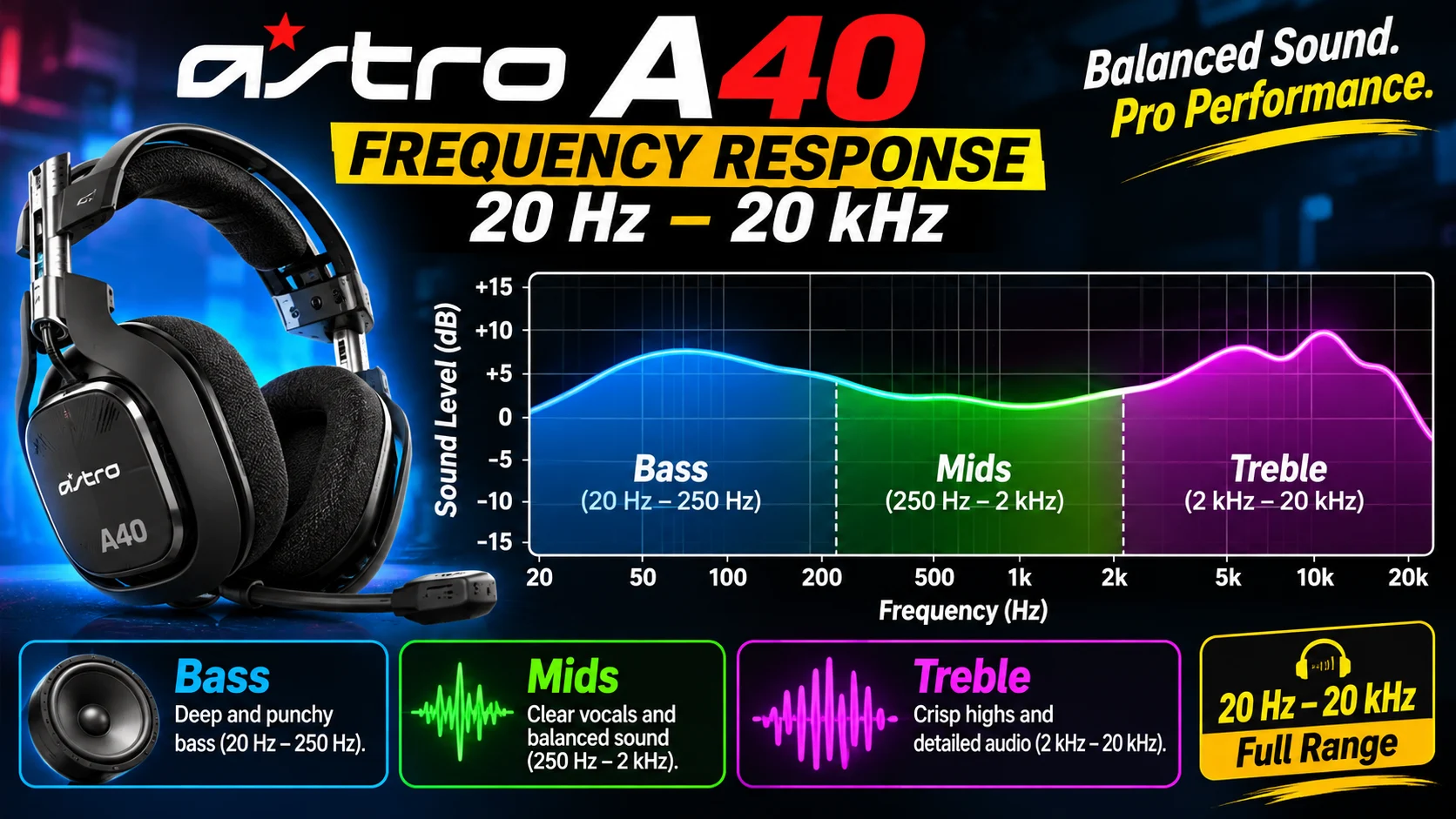
The Astro A40 frequency response is generally listed as 20 Hz to 20,000 Hz (20 kHz) for the A40 TR headset. In simple terms, it covers the commonly referenced human hearing range, while the actual sound you hear also depends on tuning, fit, source, EQ, and the specific A40 generation. Logitech Support
Ever searched for astro a40 frequency response because someone dropped the specs in a gaming thread and suddenly everyone became an audio engineer? You are definitely not alone. Whether you are comparing headsets, tweaking EQ, checking bass performance, answering a Discord question, or deciding if the A40 is still worth using, frequency response can look more complicated than it really is.
The simple answer is easy: the A40 TR is commonly rated from 20 Hz to 20 kHz. Logitech Support But that number does not tell the whole story. Your source, EQ settings, ear-pad seal, game audio, and headset tuning can all influence what you actually hear. So, if someone asks about the A40’s frequency range, you can answer with the spec, add useful context, or throw in a little gaming humor. Here are plenty of ready-to-use replies for every situation.
Funny Responses About Astro A40 Frequency Response
“20 Hz to 20 kHz. Basically, it has receipts.”
Use this when someone asks for the basic A40 frequency specification in a casual gaming chat.
Meaning: The reply gives the technical answer while keeping the tone playful.
“20 Hz to 20 kHz, because apparently numbers are part of gaming now.”
Use this when a simple headset question turns into a technical discussion.
Meaning: It humorously points out how gamers can turn audio into a full investigation.
“The A40 covers 20 Hz to 20 kHz. Your ears may tap out first.”
Use this when someone is joking about whether the headset can reproduce extreme frequencies.
Meaning: The response highlights the listed range with a playful reference to human hearing.
“20 Hz to 20 kHz. Your footsteps are safe.”
Use this when discussing the headset for competitive gaming.
Meaning: It connects the specification to the gaming experience in a humorous way.
“A40 frequency response? 20 Hz to 20 kHz. Case closed, detective.”
Use this when someone keeps investigating a basic specification.
Meaning: The answer playfully suggests that the main technical question has already been solved.
“20 Hz to 20 kHz. Numbers first, gaming second.”
Use this when answering a technical question in a gaming community.
Meaning: It presents the specification with a light gamer-friendly twist.
“The A40 says 20 Hz to 20 kHz. My EQ says we can still argue.”
Use this when discussing frequency response alongside equalizer settings.
Meaning: It acknowledges that listed specifications do not end the conversation about sound tuning.
“20 Hz to 20 kHz. Now please return to the lobby.”
Use this when giving a quick answer in a gaming group.
Meaning: It provides the information while adding familiar multiplayer humor.
“Frequency response: 20 Hz to 20 kHz. Gaming credentials: pending.”
Use this when jokingly comparing technical specifications with actual gaming performance.
Meaning: It separates the specification from real-world performance.
“20 Hz to 20 kHz, according to the spec sheet. Your playlist may have other opinions.”
Use this when someone asks whether the A40 is good for music.
Meaning: It reminds readers that a frequency range alone does not determine overall sound quality.
“A40: 20 Hz to 20 kHz. Me: still adjusting the volume.”
Use this when making a short social-media-friendly comment about the headset.
Meaning: It turns a technical specification into a relatable listening joke.
“20 Hz to 20 kHz. That is the headline, not the entire movie.”
Use this when someone treats frequency response as the only measure of headset quality.
Meaning: It explains that the specification is useful but does not tell the whole audio story.
Straightforward Responses About Astro A40 Frequency Response
“The Astro A40 TR is rated at 20 Hz to 20 kHz.”
Use this when someone simply wants the specification without extra explanation.
Meaning: It gives the direct frequency-response range.
“The listed A40 TR frequency response is 20 Hz to 20,000 Hz.”
Use this when answering a product-specification question.
Meaning: It restates the range in both common forms.
“The A40’s stated audio range is 20 Hz through 20 kHz.”
Use this when writing a concise forum or social-media response.
Meaning: It provides the commonly published range clearly.
“For the A40 TR, the published frequency response is 20 Hz to 20 kHz.”
Use this when someone asks for a reliable specification.
Meaning: It emphasizes that the number comes from the published specification.
“The A40 TR covers a stated range of 20 Hz to 20 kHz.”
Use this when responding to a technical comparison.
Meaning: It gives the core specification without making exaggerated performance claims.
“The answer is 20 Hz to 20 kHz for the A40 TR headset.”
Use this when a gaming community needs a quick answer.
Meaning: It delivers the requested information immediately.
“Astro lists the A40 TR frequency response as 20 to 20,000 Hz.”
Use this when someone wants the manufacturer’s stated specification.
Meaning: It attributes the number to the published product specification.
“The A40 TR’s listed frequency range runs from 20 Hz up to 20 kHz.”
Use this when explaining the specification to a beginner.
Meaning: It translates the technical notation into easy language.
“In basic terms, the A40 TR is specified for 20 Hz to 20 kHz.”
Use this when someone is unfamiliar with audio specifications.
Meaning: It gives a simple explanation without unnecessary jargon.
“The standard published figure for the A40 TR is 20 Hz to 20 kHz.”
Use this when comparing information from different product pages.
Meaning: It points to the commonly listed specification.
“The A40 frequency response is commonly stated as 20 Hz to 20 kHz.”
Use this when you want cautious wording around different product generations.
Meaning: It avoids implying that every A40 variant has identical measurements.
“If you only need the number, it is 20 Hz to 20 kHz.”
Use this when someone asks for a quick answer.
Meaning: It keeps the response direct and useful.
Technical Responses About Astro A40 Frequency Response
“The A40 TR’s published frequency response is 20 Hz to 20 kHz, with dynamic 40 mm drivers.”
Use this when someone wants the range plus a little hardware context.
Meaning: It connects the frequency specification to the headset’s driver design. Logitech Support
“Frequency response describes the range of frequencies the headset is specified to reproduce, not a promise of equal output across that range.”
Use this when someone assumes every frequency will sound equally loud.
Meaning: It explains the most important limitation of the specification.
“A 20 Hz to 20 kHz rating tells you the stated endpoints, but not the complete frequency-response curve.”
Use this when discussing measured audio performance.
Meaning: It explains why a single specification cannot show every peak and dip.
“The A40’s 20 Hz to 20 kHz figure should be viewed as a specification, not a complete sound signature.”
Use this when comparing the headset with another model.
Meaning: It separates technical range from subjective tuning.
“Frequency response and frequency-response consistency are two different things.”
Use this when explaining why two headsets with the same range can sound different.
Meaning: It highlights the difference between range and tonal balance.
“The A40 can cover the stated range, but the amount of energy at each frequency matters too.”
Use this when discussing bass, mids, and treble.
Meaning: It explains why frequency distribution affects perceived sound.
“20 Hz to 20 kHz tells you the range, while an actual measurement tells you how the headset behaves within that range.”
Use this when someone asks for deeper technical information.
Meaning: It distinguishes specifications from measurements.
“The published range alone cannot tell you whether the A40 sounds warm, bright, balanced, or bass-heavy.”
Use this when someone wants to predict the headset’s sound from the number alone.
Meaning: It explains why tonal descriptions require more information.
“A frequency-response graph gives more detail than simply quoting 20 Hz to 20 kHz.”
Use this when discussing audio measurements.
Meaning: It points readers toward the importance of the full curve.
“The A40’s stated frequency response covers bass, mids, and treble, but the balance between them is what shapes its character.”
Use this when explaining sound fundamentals to beginners.
Meaning: It connects technical frequency bands with perceived sound.
“The listed range is broad enough to cover the standard audible spectrum, but that does not automatically make two headsets sound identical.”
Use this when comparing gaming headsets.
Meaning: It explains why specifications alone cannot predict listening experience.
“Think of frequency response as the map, not the entire journey.”
Use this when explaining the concept in an easy way.
Meaning: It compares the specification with the broader experience of listening.
Helpful Responses About Astro A40 Frequency Response
“If you are checking the A40 specs, look for 20 Hz to 20 kHz.”
Use this when helping someone find the relevant specification.
Meaning: It directs the reader toward the key number.
“Yes, the A40 TR is commonly listed at 20 Hz to 20 kHz.”
Use this when confirming a specification someone found online.
Meaning: It provides a straightforward confirmation.
“For a quick comparison, write the A40 range as 20 Hz to 20,000 Hz.”
Use this when someone is preparing a headset comparison.
Meaning: It gives a clean format for presenting the specification.
“If you are comparing sound, do not stop at frequency response.”
Use this when someone is choosing between gaming headsets.
Meaning: It encourages a broader evaluation.
“Check the driver design, tuning, measurements, comfort, and source along with the frequency range.”
Use this when someone wants to make a purchasing decision.
Meaning: It recommends looking beyond one specification.
“The 20 Hz to 20 kHz figure is useful, but it is only one piece of the A40 audio puzzle.”
Use this when someone focuses too heavily on the specification.
Meaning: It keeps expectations realistic.
“For gaming, the frequency range matters, but imaging and positional cues matter too.”
Use this when discussing competitive gaming performance.
Meaning: It explains why range is not the only relevant audio characteristic.
“For music, compare the actual tuning rather than choosing only by the frequency-response endpoints.”
Use this when someone is considering the A40 for music listening.
Meaning: It encourages evaluation of tonal behavior.
“If your A40 sounds different from another A40 setup, check EQ and source settings first.”
Use this when two users report different listening experiences.
Meaning: It identifies settings as possible causes of variation.
“A wider number on a box does not automatically mean better sound.”
Use this when someone compares headsets solely by numerical range.
Meaning: It challenges a common misconception.
“The easiest answer is 20 Hz to 20 kHz, but the useful answer includes how the headset behaves within that range.”
Use this when answering someone who wants both the specification and context.
Meaning: It combines accuracy with practical advice.
“If you are troubleshooting sound, start with the specification, then check your EQ and audio source.”
Use this when someone reports unusual bass or treble.
Meaning: It suggests a sensible troubleshooting order.
Short Responses About Astro A40 Frequency Response
“20 Hz to 20 kHz.”
Use this when someone only wants the number.
Meaning: It provides the shortest direct answer.
“A40 TR: 20 Hz to 20 kHz.”
Use this when posting a compact specification online.
Meaning: It combines the model name with the key figure.
“The A40 is listed at 20 Hz to 20 kHz.”
Use this when answering a quick gaming question.
Meaning: It gives the commonly published range.
“20,000 Hz at the top end.”
Use this when someone specifically asks about the maximum listed frequency.
Meaning: It converts 20 kHz into the full numerical form.
“20 Hz on the low end, 20 kHz on the high end.”
Use this when explaining the two endpoints.
Meaning: It makes the frequency range easier to understand.
“Yep, 20 Hz to 20 kHz.”
Use this when replying casually to a friend.
Meaning: It confirms the specification without overexplaining.
“The listed range is 20 Hz to 20 kHz.”
Use this when you want a neutral answer.
Meaning: It provides the specification in standard terminology.
“A40 frequency range: 20 Hz to 20 kHz.”
Use this when creating a short post or comment.
Meaning: It makes the information instantly scannable.
“20 Hz through 20 kHz.”
Use this when answering in a compact technical style.
Meaning: It states the entire range without extra wording.
“20 to 20,000 Hz.”
Use this when a short numerical response is preferred.
Meaning: It gives the same range in a condensed format.
“The published A40 range is 20 Hz to 20 kHz.”
Use this when you want slightly more context than just the number.
Meaning: It identifies the number as a published specification.
“That is 20 Hz to 20 kHz for the A40 TR.”
Use this when confirming information in a thread.
Meaning: It provides a concise confirmation.
Gamer Responses About Astro A40 Frequency Response
“20 Hz to 20 kHz, which is plenty of range for gaming audio.”
Use this when discussing the A40 for everyday gaming.
Meaning: It connects the specification with gaming use without overclaiming.
“The A40 is rated 20 Hz to 20 kHz, so the spec box is doing its job.”
Use this when joking about technical specifications.
Meaning: It gives the range while keeping a gamer-friendly tone.
“For footsteps, explosions, music, and voice chat, the range covers the basics nicely.”
Use this when explaining why the range is relevant to gaming.
Meaning: It connects different gaming sounds with different frequency areas.
“20 Hz to 20 kHz. Now the real boss fight is your EQ.”
Use this when discussing headset customization.
Meaning: It humorously shifts attention from the specification to tuning.
“The A40’s listed range is 20 Hz to 20 kHz, but competitive audio is about more than numbers.”
Use this when discussing esports-style gaming.
Meaning: It reminds gamers that imaging and tuning also matter.
“The range is solid on paper, but your game settings still matter.”
Use this when someone expects the headset specification to guarantee a certain sound.
Meaning: It emphasizes the role of software and source settings.
“A40 users get the 20 Hz to 20 kHz spec. Whether your footsteps sound crisp is another story.”
Use this when discussing competitive gameplay.
Meaning: It separates frequency range from actual positional performance.
“20 Hz to 20 kHz, then let the MixAmp and EQ do their thing.”
Use this when talking about an A40 setup with audio processing.
Meaning: It acknowledges that the rest of the setup can affect the sound.
“The A40 range is 20 Hz to 20 kHz, but game audio design can make a bigger difference than the number.”
Use this when explaining why different games sound different.
Meaning: It puts the specification into a real gaming context.
“If you are chasing footsteps, do not judge the headset by frequency range alone.”
Use this when someone is choosing a competitive headset.
Meaning: It encourages looking at imaging and tuning too.
“The spec says 20 Hz to 20 kHz. Your gaming setup decides what you actually get from it.”
Use this when discussing source devices and EQ.
Meaning: It explains that the whole signal chain matters.
“A40 frequency response is the starting stat, not the final gaming score.”
Use this when someone treats specifications like a leaderboard.
Meaning: It presents frequency response as one factor among many.
Casual Responses About Astro A40 Frequency Response
“It is 20 Hz to 20 kHz, pretty straightforward.”
Use this when a friend asks casually about the headset.
Meaning: It gives the answer without turning it into a technical lecture.
“Yep, the A40 is listed at 20 Hz to 20 kHz.”
Use this when confirming something in a group chat.
Meaning: It gives a friendly confirmation.
“Basically, 20 Hz to 20 kHz is the number you want.”
Use this when helping someone quickly.
Meaning: It identifies the relevant specification.
“The A40 sits at 20 Hz to 20 kHz on the published spec.”
Use this when casually discussing headset specifications.
Meaning: It gives the standard published range.
“Nothing too mysterious: 20 Hz to 20 kHz.”
Use this when someone thinks frequency response is complicated.
Meaning: It makes the answer feel approachable.
“If you are checking the A40 specs, look for 20 Hz to 20 kHz.”
Use this when helping someone verify a listing.
Meaning: It gives them the exact figure to look for.
“That A40 range is 20 Hz to 20 kHz.”
Use this when responding in a gaming chat.
Meaning: It keeps the answer informal and direct.
“The headline number is 20 Hz to 20 kHz.”
Use this when summarizing a product specification.
Meaning: It highlights the most relevant figure.
“The A40’s published range goes from 20 Hz up to 20 kHz.”
Use this when explaining the range to a beginner.
Meaning: It translates the specification into plain language.
“Short version: 20 Hz to 20 kHz.”
Use this when someone wants the answer without extra detail.
Meaning: It signals that the response is intentionally concise.
“It is listed as 20 Hz to 20 kHz, so that is the easy answer.”
Use this when someone asks for a quick fact.
Meaning: It distinguishes the simple specification from deeper audio analysis.
“A40 frequency response? Yep, 20 Hz to 20 kHz.”
Use this when replying to a casual message or comment.
Meaning: It repeats the keyword naturally while answering.
Confident Responses About Astro A40 Frequency Response
“The A40 TR’s published frequency response is 20 Hz to 20 kHz.”
Use this when you want to sound clear and certain.
Meaning: It gives the core specification confidently.
“If we are talking about the published A40 TR spec, it is 20 Hz to 20 kHz.”
Use this when correcting conflicting information.
Meaning: It frames the answer around the published specification.
“The number to remember is 20 Hz to 20 kHz.”
Use this when someone needs a memorable answer.
Meaning: It reduces the specification to its key takeaway.
“For the A40 TR, 20 Hz to 20 kHz is the stated range.”
Use this when answering a product comparison question.
Meaning: It gives a confident but precise response.
“That is 20 Hz at the low end and 20 kHz at the high end.”
Use this when someone asks you to clarify the endpoints.
Meaning: It explains exactly what the two numbers represent.
“The published specification is clear: 20 Hz to 20 kHz.”
Use this when a discussion becomes unnecessarily complicated.
Meaning: It brings the conversation back to the basic specification.
“Do not confuse the frequency range with the full sound signature.”
Use this when correcting an oversimplified comparison.
Meaning: It confidently separates two different audio concepts.
“The A40 range is 20 Hz to 20 kHz, but that number alone does not define sound quality.”
Use this when someone makes a quality claim from the specification alone.
Meaning: It provides a balanced technical correction.
“If someone says the A40’s published range is something completely different, check the exact model first.”
Use this when different A40 generations are being discussed.
Meaning: It recognizes that product variants can create specification confusion.
“Use the exact model name before comparing frequency response.”
Use this when two product pages show different information.
Meaning: It recommends identifying the precise headset version.
“The A40 TR figure most commonly cited is 20 Hz to 20 kHz.”
Use this when discussing the headset generally.
Meaning: It gives the common specification while allowing for model differences.
“That is the clean answer: 20 Hz to 20 kHz.”
Use this when ending a technical discussion.
Meaning: It confidently summarizes the main point.
Analytical Responses About Astro A40 Frequency Response
“The 20 Hz to 20 kHz figure defines the stated endpoints, but it does not show how evenly the A40 reproduces those frequencies.”
Use this when someone wants a deeper technical explanation.
Meaning: It explains why the number alone cannot describe tonal balance.
“Two headsets can share a 20 Hz to 20 kHz rating and still sound completely different.”
Use this when comparing gaming headsets.
Meaning: It explains why identical endpoints do not guarantee identical tuning.
“Frequency response is best interpreted alongside a measured response curve.”
Use this when discussing objective headphone testing.
Meaning: It points toward a more detailed way to evaluate sound.
“The A40’s listed range does not tell you the exact bass, midrange, or treble emphasis.”
Use this when someone asks what the specification says about tonal character.
Meaning: It clarifies the limits of the published range.
“The endpoint numbers are useful, but the shape of the response is more informative for tonal analysis.”
Use this when explaining audio graphs.
Meaning: It emphasizes the importance of frequency distribution.
“A 20 kHz upper limit does not mean every sound near 20 kHz is reproduced at the same level.”
Use this when correcting a common misconception.
Meaning: It explains that frequency range does not equal flat response.
“The A40’s frequency range can describe coverage, while tuning describes character.”
Use this when explaining why specifications and listening impressions differ.
Meaning: It separates two useful ways of describing headphones.
“If you want to compare A40 sound with another headset, compare measurements and listening impressions, not just range.”
Use this when someone is researching alternatives.
Meaning: It recommends a more complete comparison method.
“The frequency-response specification is objective, but the perceived sound depends on more than that number.”
Use this when discussing subjective listening experiences.
Meaning: It balances technical information with real-world variables.
“Fit, ear shape, source, EQ, and recording quality can all influence what reaches your ears.”
Use this when explaining why two users may report different results.
Meaning: It identifies practical variables that affect listening.
“The A40 range is a useful specification, but it should never be treated as a complete sound-quality score.”
Use this when evaluating headset rankings.
Meaning: It warns against reducing audio quality to one number.
“In audio, the range tells you where the response is specified; the curve tells you much more about how it sounds.”
Use this when teaching someone the basics of headphone measurement.
Meaning: It gives a clear distinction between range and response shape.
Friendly Responses About Astro A40 Frequency Response
“The A40 TR is listed at 20 Hz to 20 kHz, so you found the right spec.”
Use this when helping someone who is researching the headset.
Meaning: It gives reassurance while providing the answer.
“Yep, 20 Hz to 20 kHz is the A40 number you will usually see.”
Use this when answering a friend’s question.
Meaning: It offers a simple and approachable explanation.
“If you are comparing A40 models, just make sure you check the exact generation.”
Use this when someone is comparing different listings.
Meaning: It encourages careful model identification.
“The easy answer is 20 Hz to 20 kHz, but there is more to headset sound than that.”
Use this when someone wants beginner-friendly context.
Meaning: It answers the question while adding useful perspective.
“Think of 20 Hz to 20 kHz as the A40’s stated frequency window.”
Use this when explaining frequency response to someone new to audio.
Meaning: It uses simple language to describe the specification.
“That number is useful, especially when comparing basic specs.”
Use this when someone is making a quick headset comparison.
Meaning: It explains where frequency response becomes helpful.
“Just remember that a bigger frequency number does not automatically mean better audio.”
Use this when someone is comparing specifications.
Meaning: It prevents a common misunderstanding.
“If the A40 sounds different after changing devices, check the EQ and audio settings too.”
Use this when someone reports inconsistent sound.
Meaning: It points toward settings that may influence the result.
“The A40’s range is easy to remember: 20 Hz to 20 kHz.”
Use this when giving a beginner a memorable fact.
Meaning: It makes the technical specification easier to retain.
“You can use 20 Hz to 20 kHz as the quick spec, then dig deeper if you care about tuning.”
Use this when someone wants both a short and detailed answer.
Meaning: It separates basic research from deeper audio analysis.
“The range answers one question, while the sound signature answers another.”
Use this when explaining why specifications and reviews may differ.
Meaning: It clearly distinguishes technical range from subjective character.
“So yes, the A40 has the range you are probably looking for.”
Use this when someone asks if the headset covers standard audible frequencies.
Meaning: It provides reassurance without making exaggerated claims.
Social Media Friendly Responses About Astro A40 Frequency Response
“A40 frequency response: 20 Hz to 20 kHz 🎧”
Use this as a compact gaming-community post or caption.
Meaning: It presents the key specification in a highly scannable format.
“20 Hz to 20 kHz. Screenshot-worthy spec, honestly.”
Use this when posting a quick headset fact.
Meaning: It makes a technical specification feel social-media friendly.
“A40 owners, your magic numbers are 20 Hz and 20 kHz.”
Use this when creating an engaging short post.
Meaning: It turns the two endpoints into an easy-to-remember hook.
“The A40 spec sheet said 20 Hz to 20 kHz, and the internet said, ‘Let us analyze everything.’”
Use this when joking about online gaming discussions.
Meaning: It pokes fun at how deeply people debate headset specifications.
“20 Hz to 20 kHz. Now cue the 47-comment EQ debate.”
Use this when posting in an audio or gaming community.
Meaning: It humorously predicts a detailed discussion after the basic specification.
“A40 frequency response explained in one line: 20 Hz to 20 kHz.”
Use this when creating an educational social post.
Meaning: It provides a concise answer designed for quick reading.
“Your A40’s spec card is basically saying 20 Hz to 20 kHz.”
Use this when explaining the product to casual followers.
Meaning: It translates technical information into informal language.
“20 Hz to 20 kHz. The spec is simple. The debates are not.”
Use this when posting about gaming audio.
Meaning: It contrasts the simplicity of the number with online discussions.
“If someone asks about the A40 frequency range, send them this: 20 Hz to 20 kHz.”
Use this when making a shareable information post.
Meaning: It positions the answer as an easy reference.
“A40 audio nerd starter pack: 20 Hz, 20 kHz, and an unnecessary EQ debate.”
Use this when targeting gaming and audio enthusiasts.
Meaning: It combines technical information with recognizable internet humor.
“20 Hz to 20 kHz is the quick answer. The rabbit hole starts after that.”
Use this when creating a curiosity-driven post.
Meaning: It suggests that deeper audio analysis requires more than the basic specification.
“Frequency response question? A40 answer: 20 Hz to 20 kHz. Boom.”
Use this when posting a short, energetic response.
Meaning: It gives the answer with confident social-media energy.
Clever Responses About Astro A40 Frequency Response
“Frequency response is the range, not the personality.”
Use this when explaining why specifications cannot fully describe headset sound.
Meaning: It cleverly separates technical coverage from tonal character.
“20 Hz to 20 kHz tells you the boundaries, not the whole story.”
Use this when someone assumes the specification explains everything.
Meaning: It gives a memorable explanation of the specification’s limitations.
“The A40 has a frequency map, but your ears experience the whole landscape.”
Use this when explaining technical audio concepts creatively.
Meaning: It compares frequency response with the broader listening experience.
“The spec gives you numbers; the tuning gives you the vibe.”
Use this when comparing technical specifications with sound character.
Meaning: It makes the distinction easy to remember.
“20 Hz to 20 kHz is the headline. The response curve is the fine print.”
Use this when discussing measured headphone performance.
Meaning: It explains why the full curve matters.
“A wide range can look impressive, but balance is where the interesting stuff happens.”
Use this when comparing different headphones.
Meaning: It emphasizes tonal balance over headline numbers.
“Frequency response answers ‘how far’; tuning answers ‘how it sounds.’”
Use this when teaching someone the difference between two audio concepts.
Meaning: It creates a simple mental model.
“The A40’s range is the skeleton. The tuning is the personality.”
Use this when explaining sound design in a memorable way.
Meaning: It presents frequency range as structure and tuning as character.
“Do not let one number become your entire headset review.”
Use this when someone judges a product solely by specifications.
Meaning: It encourages a more complete evaluation.
“20 Hz to 20 kHz is useful data, not a final verdict.”
Use this when discussing headset quality.
Meaning: It prevents overinterpreting the specification.
“If specs were the whole story, every headset would sound identical on paper.”
Use this when explaining why different products can share similar ratings.
Meaning: It highlights the limits of specification-based comparisons.
“The smart comparison starts with frequency response and finishes with actual listening.”
Use this when advising someone researching a headset.
Meaning: It recommends combining technical information with real-world experience.
Professional Responses About Astro A40 Frequency Response
“The A40 TR is commonly specified with a frequency response of 20 Hz to 20 kHz.”
Use this in a professional product discussion.
Meaning: It gives the specification in neutral, formal language.
“According to the published specification, the A40 TR covers 20 Hz to 20 kHz.”
Use this when writing a product comparison or review.
Meaning: It clearly attributes the technical information. Logitech Support
“The stated frequency response for the A40 TR is 20 Hz to 20,000 Hz.”
Use this in technical documentation or product notes.
Meaning: It presents the same specification using full numerical notation.
“The A40 TR’s frequency-response specification should be distinguished from its measured tonal response.”
Use this when writing a technically accurate comparison.
Meaning: It separates published specifications from independent measurements.
“The 20 Hz to 20 kHz specification describes the stated frequency range rather than the complete response profile.”
Use this when explaining technical specifications to readers.
Meaning: It prevents readers from confusing range with response shape.
“For comparative analysis, the frequency-response endpoints should be considered alongside independent measurements.”
Use this when conducting a serious headset comparison.
Meaning: It recommends more comprehensive technical evidence.
“The A40’s published range is relevant, but it should not be used as the sole indicator of audio quality.”
Use this in a product review or buying guide.
Meaning: It provides a balanced professional assessment.
“Frequency response provides useful baseline information about the headset’s stated audio coverage.”
Use this when explaining why the specification matters.
Meaning: It describes the practical value of the figure.
“The A40 TR’s stated range spans 20 Hz through 20 kHz.”
Use this in a concise professional summary.
Meaning: It provides the specification clearly.
“When comparing A40 variants, verify the exact model before interpreting frequency-response specifications.”
Use this when multiple generations are included in research.
Meaning: It reduces the risk of mixing specifications between models.
“The published frequency range should be interpreted in conjunction with driver design, tuning, and listening conditions.”
Use this in a detailed technical article.
Meaning: It provides a broader framework for evaluating audio performance.
“In summary, the A40 TR is commonly listed with a 20 Hz to 20 kHz frequency response.”
Use this as a professional closing statement.
Meaning: It gives the central specification in a polished form.
Buyer-Focused Responses About Astro A40 Frequency Response
“If you are buying the A40, its published frequency response is 20 Hz to 20 kHz.”
Use this when answering a potential buyer.
Meaning: It provides the main specification relevant to the purchase.
“Do not choose the A40 based on frequency response alone.”
Use this when someone asks whether the specification makes it the best headset.
Meaning: It encourages a broader buying decision.
“The 20 Hz to 20 kHz range is a useful spec, but comfort and tuning deserve equal attention.”
Use this when helping someone evaluate the headset.
Meaning: It highlights practical factors beyond frequency range.
“If you mainly play competitive games, investigate imaging and positional performance too.”
Use this when a buyer prioritizes competitive gaming.
Meaning: It identifies features that may matter more than frequency endpoints.
“If music matters to you, listen for tonal balance rather than chasing the biggest frequency numbers.”
Use this when someone wants a headset for gaming and music.
Meaning: It explains why numerical range should not drive the entire decision.
“A 20 Hz to 20 kHz rating is normal enough that it should not be your only deciding factor.”
Use this when comparing several gaming headsets.
Meaning: It puts the A40 specification into perspective.
“Look at the complete audio setup, not just the headset’s frequency-response line.”
Use this when someone uses a MixAmp or other audio equipment.
Meaning: It reminds buyers that the signal chain can influence sound.
“The A40’s listed range gives you a useful starting point for comparison.”
Use this when beginning a buying discussion.
Meaning: It treats the specification as helpful but not decisive.
“If another headset advertises a wider range, that does not automatically make it the better headset.”
Use this when comparing specifications.
Meaning: It corrects a common assumption about bigger numbers.
“Comfort, fit, soundstage, imaging, microphone quality, and tuning can matter more than the frequency endpoints.”
Use this when someone wants a complete buying checklist.
Meaning: It broadens the evaluation criteria.
“The A40 has the commonly listed 20 Hz to 20 kHz range, but your use case should decide whether it is right for you.”
Use this when giving personalized buying advice.
Meaning: It connects the specification with practical needs.
“Use frequency response as one checkbox, not the entire buying checklist.”
Use this when giving a concise purchasing recommendation.
Meaning: It offers a memorable way to evaluate specifications.
Troubleshooting Responses About Astro A40 Frequency Response
“If your A40 sounds weak in bass, check your EQ before assuming the frequency range is the problem.”
Use this when someone complains about low-end performance.
Meaning: It points toward configuration before blaming the specification.
“If the A40 sounds too bright, inspect your EQ and source settings.”
Use this when someone reports excessive treble.
Meaning: It identifies adjustable settings that may affect perceived sound.
“If one device sounds different from another, compare their audio settings first.”
Use this when the A40 behaves differently across platforms.
Meaning: It suggests checking the signal chain before assuming hardware differences.
“The published 20 Hz to 20 kHz range does not guarantee identical output from every source.”
Use this when troubleshooting different devices.
Meaning: It explains why source equipment can affect the listening experience.
“Check whether an EQ preset is active before judging the A40’s natural tuning.”
Use this when someone reports an unexpected sound.
Meaning: It encourages returning to neutral settings for comparison.
“Make sure your game and system audio settings are not changing the sound.”
Use this when troubleshooting gaming audio.
Meaning: It highlights software settings as a potential cause.
“If the bass suddenly disappeared, check the connection and audio profile before blaming frequency response.”
Use this when experiencing an abrupt change.
Meaning: It prioritizes practical troubleshooting steps.
“If the headset sounds different after an update, compare your audio settings with your previous configuration.”
Use this when someone notices a change after software changes.
Meaning: It suggests that configuration differences may explain the change.
“A frequency-response specification will not diagnose a sudden audio problem.”
Use this when someone tries to solve a hardware issue using specifications.
Meaning: It clarifies that specs are not troubleshooting tools.
“For unusual sound, test another source before concluding the A40 itself has changed.”
Use this when diagnosing inconsistent playback.
Meaning: It recommends isolating the source of the problem.
“If only one side sounds different, check the cable, connector, and balance settings.”
Use this when troubleshooting channel imbalance.
Meaning: It directs attention to common practical causes.
“Start with connections, settings, EQ, and source before making conclusions about the A40’s frequency response.”
Use this when helping someone systematically troubleshoot.
Meaning: It provides a logical troubleshooting order.
FAQs
What is the Astro A40 frequency response?
The A40 TR is commonly listed with a frequency response of 20 Hz to 20 kHz. Logitech Support
What does 20 Hz to 20 kHz mean on the Astro A40?
It describes the headset’s stated frequency range, from lower bass frequencies through higher treble frequencies.
Does the Astro A40 frequency response mean it sounds perfectly balanced?
No. Frequency-response endpoints do not show how evenly the headset reproduces frequencies throughout the range.
Is the Astro A40 frequency response good for gaming?
The stated range covers the commonly referenced audible spectrum, but gaming performance also depends on tuning, imaging, source quality, EQ, and the game itself.
Can you use the Astro A40 for music?
Yes. The A40 is designed as a gaming headset, but it can also reproduce music. Your opinion of its music performance will depend on its tuning and your personal preferences.
Does a wider frequency response mean better headphones?
Not necessarily. A wider advertised range does not automatically mean better sound quality. The actual response shape and overall tuning matter considerably more.
Conclusion
The astro a40 frequency response question looks technical at first, but the basic answer is surprisingly simple: the A40 TR is commonly listed at 20 Hz to 20 kHz. The more interesting part is understanding what that number does and does not tell you. Frequency response gives you a useful range, but it cannot describe every detail of the headset’s sound.
Whether you are answering a Reddit comment, helping a friend in Discord, comparing gaming headsets, or writing a quick social post, the best response depends on the situation. Keep it short when someone wants the number. Add context when they want to understand audio. And when in doubt, keep the tone natural. Save this guide, share it with another gamer, and use whichever reply fits the moment.