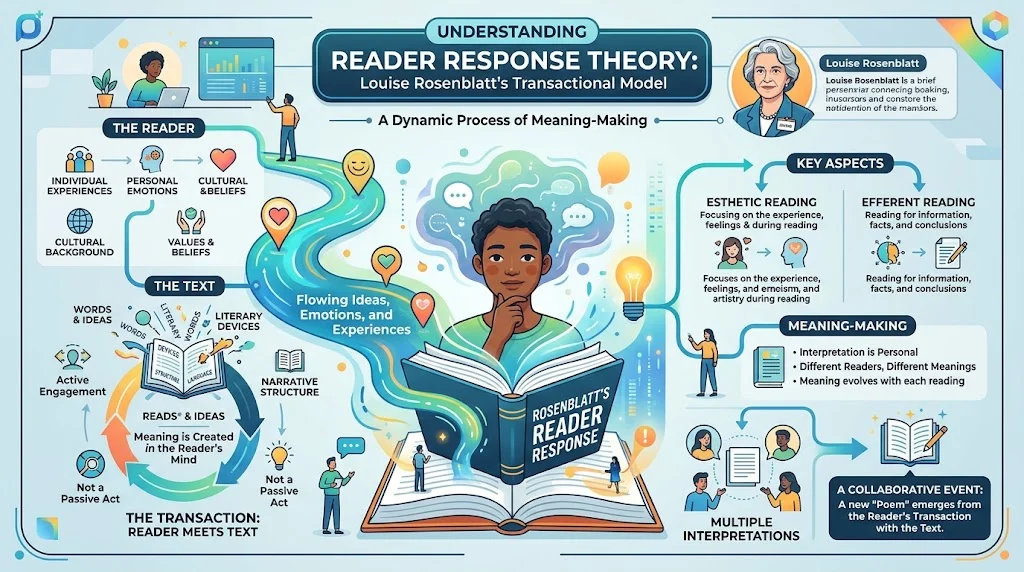
Reader response theory Rosenblatt explains reading as an active transaction between the reader and the text, with meaning shaped through the reader’s experience, context, feelings, and interpretation. Top alternatives: transactional theory, reader-centered criticism, Louise Rosenblatt’s theory, reader-text transaction, aesthetic and efferent reading.
Ever read the same story as your friend and somehow come away with two completely different meanings? That is exactly where reader response theory Rosenblatt becomes interesting. Louise Rosenblatt’s transactional view of reading treats meaning as something that develops through the relationship between the reader and the text, rather than something sitting inside the words waiting to be discovered. You can see the idea in classrooms, essays, book clubs, study groups, DMs about books, and those late-night conversations that somehow turn into literary debates. Your background, emotions, expectations, and purpose can all shape what you notice. So, when someone asks you to explain Rosenblatt’s theory, having the right response matters. Whether you need a simple classroom answer, a polished academic explanation, or a clever way to describe the concept, these responses make the theory easier to understand and remember.
Clear Responses
Meaning is created through the reader’s interaction with the text.
Use this when you need a simple explanation for a class discussion.
Meaning: The response emphasizes Rosenblatt’s central idea that reading involves an active transaction.
Rosenblatt sees reading as a transaction, not just information transfer.
Use this when explaining the theory to someone learning literary criticism.
Meaning: The response highlights the active relationship between reader and text.
The reader helps shape the meaning of a text.
Use this when answering a basic exam question.
Meaning: Interpretation depends partly on the reader’s engagement with the text.
Different readers can reasonably interpret the same text differently.
Use this when explaining why literary interpretations can vary.
Meaning: Personal experience and context can influence interpretation.
Rosenblatt puts the reader inside the meaning-making process.
Use this when you want a memorable classroom explanation.
Meaning: Reading becomes an interactive experience rather than passive reception.
A text does not produce exactly the same response in every reader.
Use this when discussing individual interpretation.
Meaning: Readers bring different perspectives and experiences to reading.
Reading involves both the text and the reader.
Use this when giving a very short answer.
Meaning: Rosenblatt’s theory focuses on the relationship between the two.
The reader’s experience matters in interpretation.
Use this when introducing reader-centered criticism.
Meaning: Personal response can contribute to literary meaning.
Rosenblatt describes reading as an active experience.
Use this when contrasting her theory with passive reading.
Meaning: Readers actively construct understanding while engaging with texts.
Interpretation can change depending on who is reading.
Use this when explaining reader differences.
Meaning: Individual perspectives influence how texts are experienced.
The meaning of a text emerges during the reading transaction.
Use this for a more academic response.
Meaning: Meaning develops through the encounter between reader and text.
Rosenblatt makes reading personal without making it completely arbitrary.
Use this when someone assumes reader response means anything goes.
Meaning: Readers contribute to interpretation while still responding to an actual text.
Funny Responses
So, apparently, the book needs me too.
Use this when explaining Rosenblatt’s reader-centered approach with humor.
Meaning: The joke shows that the reader actively participates in meaning-making.
Plot twist: the reader is part of the equation.
Use this when introducing the transactional idea in a casual setting.
Meaning: The response humorously emphasizes the reader’s role.
The text said one thing, my brain said, “Interesting.”
Use this when joking about personal interpretation.
Meaning: The response highlights how readers bring their own perspectives.
Same book, different brains, different interpretations.
Use this for a light classroom comment.
Meaning: Readers may construct different meanings from the same text.
Rosenblatt basically said reading is a two-person conversation.
Use this when simplifying the transaction metaphor.
Meaning: The response presents reading as an interaction between reader and text.
The book isn’t talking to itself.
Use this when making the concept memorable.
Meaning: Meaning develops through engagement with a reader.
Reader response theory said, “Your experience matters.”
Use this as a playful summary.
Meaning: The response captures the importance of personal experience.
Apparently, my reading mood made the syllabus.
Use this when discussing how circumstances can affect interpretation.
Meaning: A reader’s situation can influence the reading experience.
My childhood just joined the literature discussion.
Use this when explaining personal background.
Meaning: Past experiences can affect how readers respond to texts.
The text brought receipts, but I brought context.
Use this when joking about interpretation.
Meaning: Readers contribute experiences and perspectives to the transaction.
Literary analysis, but make it personal.
Use this for a playful classroom response.
Meaning: The response points to the reader’s role in interpretation.
Turns out reading is not just downloading information.
Use this when contrasting active and passive reading.
Meaning: Reading involves active engagement rather than simple information collection.
Flirty Responses
Even books need chemistry between two sides.
Use this when making the theory sound playful in a casual conversation.
Meaning: The response compares reader-text interaction with interpersonal chemistry.
It’s all about the connection between the reader and the text.
Use this when giving a light explanation.
Meaning: Rosenblatt focuses on the relationship formed during reading.
Different readers bring different energy to the same story.
Use this when discussing individual responses.
Meaning: Readers’ perspectives affect their experiences with texts.
The text starts the conversation, but the reader joins in.
Use this when explaining transactional reading creatively.
Meaning: Meaning develops through interaction.
Reading is basically intellectual chemistry.
Use this when using a playful metaphor.
Meaning: The response describes interpretation as something emerging through interaction.
A good text gives your brain something to work with.
Use this when explaining active engagement.
Meaning: Readers actively process and respond to what they encounter.
The reader and text have to meet halfway.
Use this when simplifying Rosenblatt’s approach.
Meaning: Meaning involves contributions from both sides of the transaction.
Interpretation is where the connection gets interesting.
Use this when introducing reader differences.
Meaning: Readers may experience different meanings through engagement.
The text brings the words; the reader brings the experience.
Use this when making the theory memorable.
Meaning: The response separates textual material from reader contribution.
Reading gets interesting when the reader gets involved.
Use this for a casual explanation.
Meaning: Active participation is central to Rosenblatt’s approach.
The real chemistry happens during the reading.
Use this as a playful classroom line.
Meaning: Meaning emerges through the reading transaction.
Different readers, different sparks of meaning.
Use this when discussing interpretation.
Meaning: Personal engagement can produce varied responses.
Polite Responses
Rosenblatt’s theory recognizes the importance of the reader’s experience.
Use this in a respectful classroom discussion.
Meaning: The response acknowledges the reader as an important part of interpretation.
I think the key idea is the relationship between reader and text.
Use this when offering your interpretation carefully.
Meaning: The response identifies the central transactional relationship.
One useful way to understand Rosenblatt is through the idea of transaction.
Use this when introducing the theory to classmates.
Meaning: Transaction provides a practical framework for understanding her approach.
Readers can respond differently while engaging with the same text.
Use this when discussing varied interpretations.
Meaning: Individual readers may experience different meanings.
The theory gives attention to personal reading experiences.
Use this when summarizing the reader-centered element.
Meaning: Reader experience becomes part of interpretation.
Rosenblatt’s approach encourages readers to consider their own responses.
Use this in an academic conversation.
Meaning: Reflection on personal response is relevant to interpretation.
The text remains important, but the reader also matters.
Use this when clarifying a common misunderstanding.
Meaning: Transactional theory does not simply remove the text from interpretation.
Context can influence how a reader experiences a work.
Use this when discussing interpretation carefully.
Meaning: A reader’s circumstances may shape the reading event.
Purpose can also affect how we read a text.
Use this when introducing different reading stances.
Meaning: Reading for information differs from reading for lived experience.
Rosenblatt gives us a useful way to think about literary response.
Use this as a balanced classroom statement.
Meaning: The theory offers a framework for understanding reading experiences.
The reader’s contribution is part of the larger reading event.
Use this in a written discussion.
Meaning: Interpretation develops through interaction rather than isolation.
That interpretation makes sense when we consider Rosenblatt’s transactional model.
Use this when connecting a comment to the theory.
Meaning: The response links reader experience with Rosenblatt’s framework.
Professional Responses
Rosenblatt conceptualizes reading as a transaction between reader and text.
Use this in an academic presentation.
Meaning: The response gives a concise professional description of transactional theory.
Her approach emphasizes the dynamic nature of meaning-making.
Use this in an essay or lecture.
Meaning: Meaning develops through an active reading event.
The reader’s stance and experience influence the reading transaction.
Use this when discussing interpretive differences.
Meaning: Reading conditions affect how texts are experienced.
Rosenblatt distinguishes between aesthetic and different stances.
Use this when discussing one of her most important concepts.
Meaning: Readers may approach texts with different purposes and orientations.
An aesthetic stance focuses more on the lived experience of reading.
Use this when defining aesthetic reading.
Meaning: Attention centers on what is being experienced during the reading.
A different stance focuses on what the reader takes away from the text.
Use this when explaining different readings.
Meaning: Attention centers on information, conclusions, or practical outcomes.
The two stances describe different ways of approaching a reading event.
Use this when comparing aesthetic and different reading.
Meaning: Readers can approach the same text with different purposes.
Rosenblatt’s model gives the reader an active role in interpretation.
Use this in an academic response.
Meaning: The reader participates in constructing meaning.
The theory connects textual material with individual reading experience.
Use this in a research discussion.
Meaning: Meaning emerges through interaction rather than text alone.
Interpretation occurs within a particular reading situation.
Use this when discussing context.
Meaning: Reading is influenced by circumstances surrounding the transaction.
Reader response is therefore more than simply expressing an opinion.
Use this when correcting an oversimplification.
Meaning: A response involves interaction with textual and experiential elements.
Rosenblatt’s transactional theory provides a framework for understanding active reading.
Use this as a concluding academic statement.
Meaning: The theory explains reading as an interactive process.
Creative Responses
Think of reading as a conversation where the page gets the first word.
Use this when teaching the theory creatively.
Meaning: The metaphor presents reading as an interaction.
The text provides the material, while the reader brings a perspective.
Use this when explaining reader contributions.
Meaning: Interpretation combines textual elements with reader experience.
Every reading event is its own little meeting between person and page.
Use this in a presentation or classroom discussion.
Meaning: Each reading experience can be shaped by the individual reader.
A story can stay the same while the experience changes.
Use this when discussing multiple interpretations.
Meaning: Different readers can experience one text differently.
Reading is where words meet memory, emotion, purpose, and attention.
Use this when explaining the richness of interpretation.
Meaning: Several reader factors can influence the reading experience.
The page supplies language; the reader supplies lived experience.
Use this as a memorable summary.
Meaning: The response emphasizes interaction between text and reader.
A book can be stable while its reading experiences keep moving.
Use this when explaining transactional reading.
Meaning: The physical text remains while readers experience it differently.
Interpretation is the meeting point between text and reader.
Use this for a creative academic explanation.
Meaning: Meaning develops through the encounter.
Reading is not just seeing words; it is experiencing them.
Use this when introducing aesthetic reading.
Meaning: Aesthetic reading emphasizes the experience of the reading event.
Sometimes we read for the answer, and sometimes we read for the experience.
Use this when comparing reading stances.
Meaning: The statement distinguishes practical and experiential purposes.
The same paragraph can become a different experience in a different reader.
Use this when discussing individual responses.
Meaning: Reader context can influence interpretation.
Rosenblatt turns reading into an event rather than a simple transfer of information.
Use this as a creative summary.
Meaning: Reading is presented as an active transaction.
Sarcastic Responses
Because apparently the book doesn’t get to do all the interpretive work.
Use this when joking about reader participation.
Meaning: The response humorously emphasizes the active reader.
Yes, your personal experience has entered the literary chat.
Use this when explaining reader response.
Meaning: Reader background can influence interpretation.
Congratulations, you’re officially part of the reading process.
Use this when introducing transactional theory.
Meaning: The reader contributes to meaning-making.
The author wrote it, but your reading experience still matters.
Use this when correcting an overly author-centered interpretation.
Meaning: Rosenblatt gives attention to the reader’s role.
Same book, different humans. Revolutionary concept, apparently.
Use this as playful commentary on varied interpretations.
Meaning: Different readers can produce different responses.
No, the text did not come with one universal emotional setting.
Use this when discussing different reading experiences.
Meaning: Readers may respond differently to the same work.
Your brain did more than just scan the page.
Use this when explaining active reading.
Meaning: Reading involves mental and experiential engagement.
The book is not a vending machine for one correct reaction.
Use this when discussing interpretation.
Meaning: Reader response recognizes variation in reading experiences.
Plot twist: context matters.
Use this as a quick explanation of reader influence.
Meaning: Context can shape interpretation.
Turns out reading with zero personal involvement is not the whole story.
Use this when contrasting passive and active reading.
Meaning: Rosenblatt views reading as interactive.
The page has words. You have a whole backstory.
Use this when explaining reader experience.
Meaning: Readers bring prior experiences to the transaction.
Literature just got personal.
Use this as a humorous summary.
Meaning: The response highlights the importance of reader experience.
Cute Responses
Books meet readers, and meaning happens.
Use this when explaining the theory simply.
Meaning: Meaning emerges through reader-text interaction.
Every reader brings a little something to the page.
Use this when discussing reader contribution.
Meaning: Personal experience influences reading.
The text and reader make meaning together.
Use this when teaching the central idea.
Meaning: Both sides participate in the reading transaction.
A familiar story can feel new in a different moment.
Use this when discussing changing reader experiences.
Meaning: Reading circumstances can influence interpretation.
Your reading experience is part of the story of reading.
Use this when making the concept personal.
Meaning: The reader’s experience contributes to the transaction.
Sometimes a book meets you at exactly the right moment.
Use this when explaining emotional reading.
Meaning: Personal circumstances can affect how a text is experienced.
The words stay, but your perspective can change.
Use this when discussing rereading.
Meaning: A reader’s changing context can affect interpretation.
Reading is a little meeting between you and the page.
Use this with younger students.
Meaning: The phrase simplifies the transactional concept.
Different readers can find different meanings in the same story.
Use this when explaining interpretive diversity.
Meaning: Individual experiences influence responses.
A book can feel different at different times in your life.
Use this when explaining reader context.
Meaning: Life experience can affect reading.
The reader brings the feelings; the text gives them something to meet.
Use this as a warm metaphor.
Meaning: Reading combines reader experience with textual material.
Good reading leaves room for your own response.
Use this when introducing reader-centered interpretation.
Meaning: Readers actively engage with texts.
Dramatic Responses
And then the reader entered the story’s meaning.
Use this as a dramatic introduction to Rosenblatt.
Meaning: The reader becomes an active part of interpretation.
The text was never alone in the room.
Use this when explaining the reader-text relationship.
Meaning: Meaning involves both text and reader.
One book. One reader. An entirely different experience.
Use this when discussing varied interpretations.
Meaning: Individual readers can experience texts differently.
The words remained, but the meaning shifted with the reader.
Use this when discussing interpretation.
Meaning: Reader context can influence meaning.
This is where reading becomes a transaction.
Use this when introducing Rosenblatt’s central concept.
Meaning: Reading becomes an active encounter.
The page spoke, and the reader answered.
Use this as a dramatic metaphor.
Meaning: Reading involves interaction between text and reader.
The real action happens between the lines and the reader.
Use this in a presentation.
Meaning: Interpretation develops through engagement.
A text can begin the experience, but the reader helps shape it.
Use this when explaining reader participation.
Meaning: The reader contributes to meaning-making.
Then came the reader’s history, emotions, and expectations.
Use this when discussing contextual influence.
Meaning: Reader factors can shape the reading experience.
The same sentence can land differently for different people.
Use this when explaining varied responses.
Meaning: Individual experience affects interpretation.
Reading became an event, not just an act of decoding.
Use this when explaining transactional reading.
Meaning: Rosenblatt views reading as an active experience.
And suddenly, interpretation was no longer one-size-fits-all.
Use this as a memorable summary.
Meaning: Reader differences can produce different interpretations.
Chill And Casual Responses
Basically, reader and text work together.
Use this when explaining Rosenblatt to a friend.
Meaning: The response gives a simple summary of transactional theory.
Your reading experience matters.
Use this when someone asks for the shortest explanation.
Meaning: Reader experience is central to the theory.
Same book, different reader, different experience.
Use this when discussing interpretation casually.
Meaning: Readers can respond differently to identical texts.
It’s about what happens when you and the text interact.
Use this when avoiding academic jargon.
Meaning: The reading transaction produces meaning.
Rosenblatt makes reading feel a lot more interactive.
Use this in an informal study conversation.
Meaning: The theory treats reading as an active process.
You don’t just read the text; you respond to it.
Use this when explaining reader activity.
Meaning: Readers actively participate in interpretation.
Your background can affect what you notice.
Use this when explaining context.
Meaning: Previous experience can influence reading.
Your purpose for reading can change the experience too.
Use this when discussing reading stances.
Meaning: Readers approach texts differently depending on their purpose.
Reading for information is not the same as reading for the experience.
Use this when introducing Rosenblatt’s two stances.
Meaning: Efferent and aesthetic reading emphasize different purposes.
The text matters, but so does the person reading it.
Use this when correcting a common misunderstanding.
Meaning: Transactional theory includes both reader and text.
Think less “answer sheet” and more “reading experience.”
Use this when simplifying the concept.
Meaning: The theory emphasizes active engagement.
It’s basically a reader-text interaction.
Use this when you need a quick study response.
Meaning: The phrase captures the core transactional idea.
Confident Responses
Rosenblatt’s key idea is that meaning emerges through a transaction between reader and text.
Use this when answering confidently in class.
Meaning: The response identifies the central principle of her theory.
The reader is an active participant in meaning-making.
Use this when discussing reader response.
Meaning: Readers contribute to interpretation.
Rosenblatt does not treat reading as a purely passive process.
Use this when comparing approaches.
Meaning: Reading involves active engagement.
The reading event depends on the interaction between reader and text.
Use this in an academic answer.
Meaning: Transaction is central to interpretation.
A reader’s stance can influence the reading experience.
Use this when discussing aesthetic and different reading.
Meaning: Purpose and orientation affect engagement.
Aesthetic reading emphasizes what the reader experiences during reading.
Use this when defining aesthetic stance.
Meaning: Attention centers on the lived experience of the reading event.
Different readings emphasize what the reader carries away afterward.
Use this when explaining different stances.
Meaning: Attention centers on information, conclusions, or practical outcomes.
Reader response is not simply personal opinion without textual engagement.
Use this when correcting a misconception.
Meaning: Reader response remains connected to interaction with the text.
The same text can generate different responses without becoming meaningless.
Use this when discussing interpretation.
Meaning: Variation does not eliminate the importance of the text.
Context helps explain why readers may experience texts differently.
Use this when discussing reader differences.
Meaning: Circumstances can influence interpretation.
Rosenblatt gives us a framework for understanding reading as an active event.
Use this in a written assignment.
Meaning: Her theory explains reading through interaction.
That is why Rosenblatt remains important in discussions of reader-centered interpretation.
Use this as a concluding point.
Meaning: The response connects her theory with reader-focused criticism.
Emotional Responses
Sometimes a book hits differently because you are different.
Use this when explaining changing personal responses.
Meaning: Changes in the reader can affect the reading experience.
A story can touch one reader deeply and another only mildly.
Use this when discussing emotional variation.
Meaning: Readers can have different emotional responses to the same text.
What we bring emotionally can shape what we experience.
Use this when discussing personal responses.
Meaning: Emotional context can influence reading.
A familiar story can feel completely new during a difficult season.
Use this when explaining contextual influence.
Meaning: Personal circumstances can alter interpretation.
Reading can connect the text with memories we already carry.
Use this when discussing prior experience.
Meaning: Readers may connect textual material with personal memories.
The reader does not arrive at the page empty.
Use this when introducing reader experience.
Meaning: Readers bring prior knowledge, feelings, and expectations.
Our experiences can change what a story means to us.
Use this in a reflective classroom response.
Meaning: Personal history contributes to interpretation.
A text can become meaningful through the experience of reading it.
Use this when discussing aesthetic reading.
Meaning: Meaning develops during the reading transaction.
Sometimes we remember how a book made us feel as much as what happened.
Use this when explaining aesthetic experience.
Meaning: Aesthetic reading focuses attention on lived experience.
The reader’s emotional response can become part of the reading event.
Use this in a literary discussion.
Meaning: Emotion can contribute to the transaction.
Different lives create different encounters with the same words.
Use this as a reflective summary.
Meaning: Reader backgrounds can influence interpretation.
That is why rereading a book years later can feel completely different.
Use this when discussing changing readers.
Meaning: A reader’s changed circumstances can affect the transaction.
Sweet Responses
The reader brings experience, and the text gives that experience something to explore.
Use this when giving a warm explanation.
Meaning: Reading combines personal experience with textual material.
A book can meet readers differently at different points in life.
Use this when discussing rereading.
Meaning: Changing circumstances can influence interpretation.
Meaning grows through the relationship between reader and text.
Use this when summarizing Rosenblatt poetically.
Meaning: Transaction creates the conditions for meaning-making.
The reader and text each have a role in the experience.
Use this when clarifying the transactional model.
Meaning: Both reader and text matter.
Every reading experience has its own context.
Use this when discussing individual responses.
Meaning: Reading takes place within particular circumstances.
The words stay on the page, but the experience can change.
Use this when explaining rereading.
Meaning: Reader context can alter interpretation.
A reader’s perspective can bring new meaning into focus.
Use this when discussing interpretation.
Meaning: Different perspectives can highlight different textual possibilities.
Reading becomes richer when we notice how we respond.
Use this in a classroom reflection.
Meaning: Awareness of personal response can deepen reading.
The text gives us something to encounter, not merely something to memorize.
Use this when explaining aesthetic engagement.
Meaning: Reading can involve experience as well as information.
Our experiences become part of how we encounter stories.
Use this when discussing reader background.
Meaning: Personal context influences reading.
Sometimes the meaning is in the meeting between the page and the person.
Use this as a memorable metaphor.
Meaning: Meaning develops through interaction.
That is the heart of Rosenblatt’s transactional view of reading.
Use this as a warm concluding response.
Meaning: The response summarizes her emphasis on reader-text interaction.
Clever Responses
The text supplies possibilities; the reader activates the reading experience.
Use this when giving a concise intellectual explanation.
Meaning: Meaning develops through reader engagement with textual material.
Reading is less like receiving a message and more like participating in an event.
Use this when contrasting passive and active reading.
Meaning: Rosenblatt presents reading as transactional.
The reader’s stance can change the kind of experience a text produces.
Use this when discussing aesthetic and different reading.
Meaning: Reading purpose influences engagement.
Aesthetic reading focuses on what is being lived through during reading.
Use this when explaining aesthetic stance.
Meaning: Attention centers on the experience of the reading event.
Different readings focus on what remains useful after reading.
Use this when explaining different stances.
Meaning: Attention centers on information or outcomes.
The meaning is not simply stored inside the text like a hidden file.
Use this when explaining transactional theory to beginners.
Meaning: Meaning emerges through interaction.
Reader response asks what happens when a particular reader meets a particular text.
Use this when giving a conceptual explanation.
Meaning: The reading event depends on a specific reader-text encounter.
Interpretation is shaped by both textual cues and reader experience.
Use this in a literature discussion.
Meaning: Readers respond to textual material through their own contexts.
The reader does not replace the text; the reader interacts with it.
Use this when correcting a common misunderstanding.
Meaning: Rosenblatt’s approach remains transaction-based.
A reading can change when the reader’s purpose changes.
Use this when comparing reading situations.
Meaning: Different purposes can produce different reading stances.
Meaning-making happens during the transaction, not before it.
Use this when explaining the theory succinctly.
Meaning: Interpretation develops through the reading event.
Rosenblatt makes the reading process dynamic instead of one-directional.
Use this as a strong academic summary.
Meaning: Reading becomes an interaction rather than a simple transfer.
Student-Friendly Responses
Rosenblatt says readers and texts work together to create meaning.
Use this for a simple homework answer.
Meaning: The response explains transactional theory in accessible language.
The reader’s experiences can affect how a text is understood.
Use this in a classroom assignment.
Meaning: Personal context can influence interpretation.
Two students can read the same story and understand it differently.
Use this when giving a practical example.
Meaning: Individual readers can have different responses.
Reading is active because readers respond to what they read.
Use this when explaining the theory to classmates.
Meaning: Readers participate in meaning-making.
Rosenblatt calls the relationship between reader and text a transaction.
Use this when defining the key term.
Meaning: Transaction describes the interaction involved in reading.
Aesthetic reading focuses on the experience of reading.
Use this for an exam definition.
Meaning: Aesthetic stance emphasizes what the reader experiences during reading.
Different reading focuses on what the reader takes away.
Use this for a short study note.
Meaning: Different stances emphasize information or outcomes.
Your reason for reading can affect how you read.
Use this when explaining the purpose of reading.
Meaning: Purpose influences reading stance.
Your background can affect what stands out to you.
Use this when explaining individual interpretation.
Meaning: Prior experiences can influence attention and response.
Reader response does not mean every interpretation is automatically correct.
Use this when clarifying a common misconception.
Meaning: Reader response still involves engagement with the text.
The text matters, but the reader’s experience matters too.
Use this when summarizing the theory.
Meaning: Both sides contribute to the transaction.
In simple terms, Rosenblatt sees reading as an interaction.
Use this as a final study answer.
Meaning: The response captures the basic concept without jargon.
FAQs
What does reader response theory Rosenblatt mean? It refers to Louise Rosenblatt’s transactional approach, which explains reading as an active relationship between a reader and a text, with meaning developing through the reading experience.
What is Rosenblatt’s main idea? Her main idea is that meaning emerges through a transaction between reader and text rather than being produced by the text alone.
Is Rosenblatt’s theory emotional or personal? It can include emotional and personal responses because readers bring experiences, expectations, knowledge, and purposes to the reading event.
What is the difference between aesthetic and different reading? Aesthetic reading emphasizes what the reader experiences during reading, while different reading emphasizes what the reader takes away after reading.
Can reader response theory be used professionally? Yes. It can be discussed in literary studies, education, classroom teaching, reading instruction, and academic analysis.
What if I do not personally connect with a text? You can still analyze your response by explaining what you noticed, expected, questioned, or experienced while reading.
Is every reader’s interpretation automatically correct? No. Reader response recognizes individual experience, but interpretations can still be examined through the actual text and the reasoning used to support them.
Why can two readers interpret the same book differently? Readers have different backgrounds, experiences, purposes, expectations, and responses, which can shape their encounters with the same text.
Is humor appropriate when explaining Rosenblatt’s theory? Yes, especially in casual study conversations, social posts, or classroom examples, as long as the humorous explanation remains accurate.
Can I use Rosenblatt’s theory in an essay? Yes. You can use the theory to discuss how a reader’s experience, stance, and interaction with a text contribute to interpretation.
Why is the reader important in Rosenblatt’s theory? The reader actively participates in the reading transaction, so the reading event involves more than simply receiving information from a text.
What is the easiest way to remember Rosenblatt? Think of three ideas: reader, text, and transaction. The reader encounters the text, and meaning develops through that interaction.
Conclusion
Reader response theory Rosenblatt becomes much easier to understand once you stop thinking of reading as simply finding the one answer hidden inside a book. Rosenblatt’s transactional approach gives attention to the reader, the text, the purpose of reading, and the experience created during the encounter. Whether you need a quick classroom explanation, an academic response, a discussion point, or a memorable way to explain aesthetic and efferent reading, the right wording can make the concept click. Try different responses depending on your audience and situation. Save this guide for your next literature discussion, share it with a classmate, or reuse your favorite explanations when studying. Keep reading, keep questioning, and let your interpretation join the conversation.