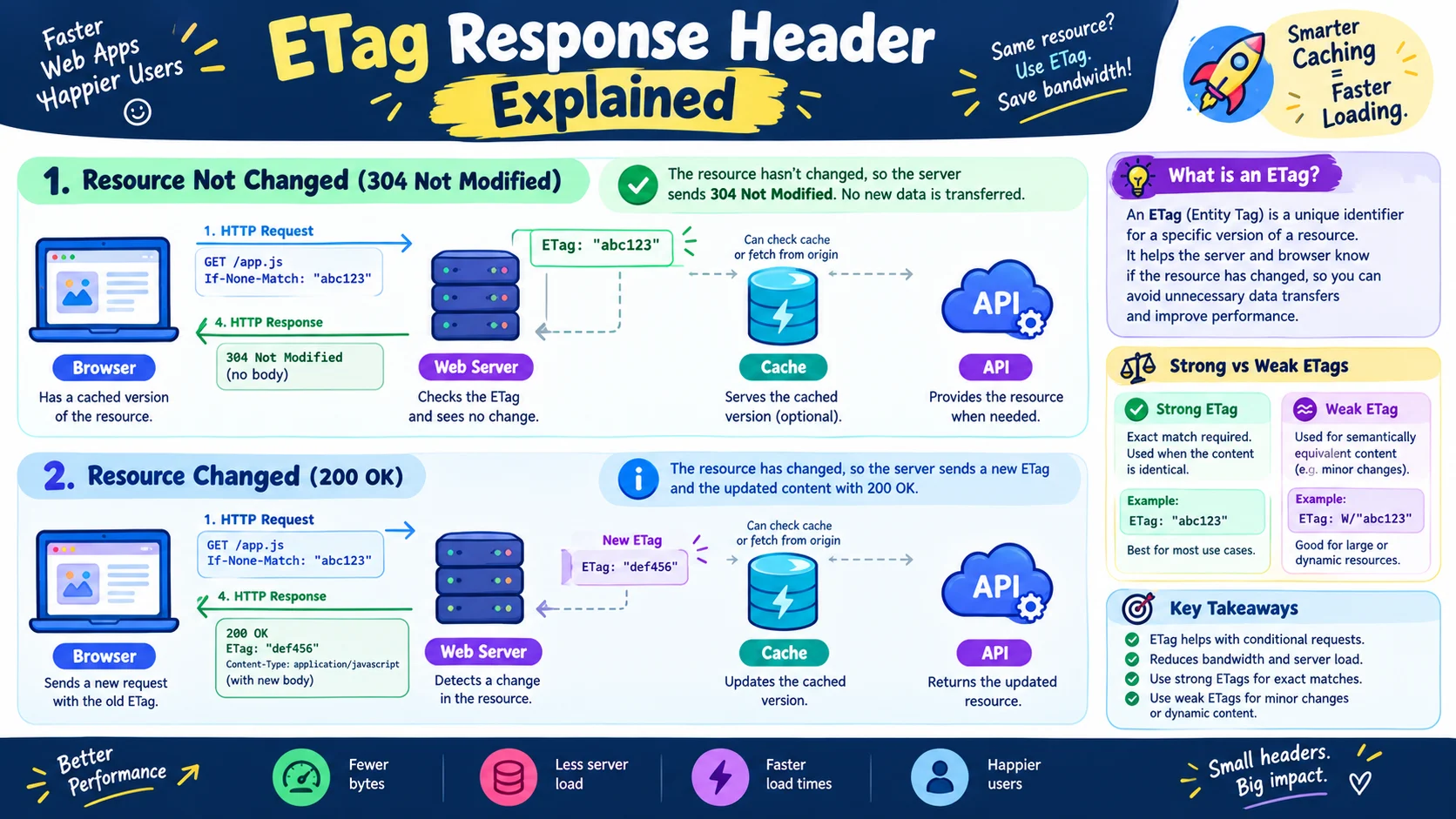
The etag response header identifies a particular version of an HTTP resource so browsers, caches, and servers can check whether that resource has changed. It commonly works with If-None-Match and can help return 304 Not Modified instead of sending the full resource again.
Top alternatives: HTTP ETag, entity tag, cache validator, HTTP cache validation, resource version identifier
The ETag response header is one of those tiny HTTP details that looks mysterious until you see what it actually does. It gives a resource a validator that can be compared later to determine whether the selected representation has changed.
Funny ETag Response Header Explanations
ETag is basically the web saying, “Did this change or nah?”
Use this when explaining HTTP caching to someone who dislikes technical jargon.
Meaning: The ETag helps determine whether a resource has changed.
It is the website’s tiny version checker.
Use this when introducing ETags to a beginner.
Meaning: The value helps identify a particular representation of a resource.
ETag keeps asking, “Same file as last time?”
Use this when making cache validation easier to visualize.
Meaning: A matching ETag can tell the server that the cached representation is still valid.
Think of ETag as a digital “still the same” sticker.
Use this for a casual technical explanation.
Meaning: The validator helps compare a current representation with an earlier one.
ETag saves your bandwidth from unnecessary cardio.
Use this when discussing why caching can reduce repeated transfers.
Meaning: A validated cache can avoid retransmitting an unchanged response body.
ETag is HTTP doing a quick identity check.
Use this when explaining validators without diving into implementation details.
Meaning: The server uses the tag to differentiate representations.
It is the web’s version of “We already have that.”
Use this when explaining a 304 Not Modified response.
Meaning: A matching validator can allow the client to reuse its cached copy.
ETag: because downloading the same thing twice feels unnecessary.
Use this in a developer-friendly social post.
Meaning: Conditional requests can reduce redundant transfers.
ETag is the bouncer checking whether your cached version still gets in.
Use this when teaching HTTP caching with humor.
Meaning: The validator helps determine whether a stored representation remains usable.
It gives your resource a little digital name tag.
Use this when someone asks what an entity tag actually represents.
Meaning: The ETag identifies a selected representation with an opaque value.
ETag is basically “same version, different day?”
Use this as a beginner-friendly explanation.
Meaning: The tag lets a client and server compare resource versions.
Small header, surprisingly useful job.
Use this when introducing the header in a quick post.
Meaning: ETag supports cache validation and conditional requests.
Brutal Truths About ETag
ETag is not the response body.
Use this when correcting someone who treats the header as content.
Meaning: ETag is metadata associated with the selected representation.
ETag is not a magic speed button.
Use this when explaining that caching still depends on correct HTTP behavior.
Meaning: ETags support validation but do not automatically make every request faster.
A matching ETag does not mean “send everything again.”
Use this when explaining conditional GET behavior.
Meaning: A match can result in 304 Not Modified for GET or HEAD requests.
ETag does not tell you what the resource contains.
Use this when someone assumes the value is readable metadata.
Meaning: Entity tags are opaque validators rather than descriptions of content.
ETag is not automatically a cryptographic hash.
Use this when discussing how servers generate values.
Meaning: Implementations can use hashes, revision identifiers, timestamps, or other suitable mechanisms.
ETag does not replace every caching header.
Use this when comparing HTTP cache mechanisms.
Meaning: ETag works alongside other mechanisms such as Cache-Control and Last-Modified.
A weak ETag is not a strong validator.
Use this when discussing W/ prefixes.
Meaning: A weak entity tag uses weaker comparison semantics than a strong validator.
ETag does not automatically prevent every update conflict.
Use this when discussing concurrent edits.
Meaning: Conflict prevention can involve ETag with headers such as If-Match.
A changed resource should not casually keep the same validator.
Use this when explaining validator generation.
Meaning: The validator needs to distinguish representations appropriately.
ETag is not something you send only from the browser.
Use this when explaining request and response roles.
Meaning: ETag is a response header, while If-None-Match and If-Match are request headers.
304 is not an error.
Use this when someone sees a 304 in browser developer tools.
Meaning: 304 Not Modified tells the client that its cached representation can be reused.
The ETag value is intentionally opaque.
Use this when someone asks what a random-looking tag means.
Meaning: Clients are expected to compare it rather than interpret its internal construction.
Flirty ETag Response Header Explanations
You changed, but my ETag noticed first.
Use this as a playful caption for developer content.
Meaning: The joke compares resource validation with noticing a change.
Are we still compatible? Let the ETag decide.
Use this for a playful HTTP-themed post.
Meaning: The ETag can be compared to determine representation compatibility.
Your cache remembered you. Cute.
Use this when making browser caching sound playful.
Meaning: A cached representation can be validated against a current ETag.
ETag said, “I remember this version.”
Use this when explaining conditional requests casually.
Meaning: The validator represents a previously received representation.
No update? Perfect, stay cached.
Use this when describing a successful cache validation scenario.
Meaning: An unchanged resource may not need to be transferred again.
You brought the same ETag back. I respect consistency.
Use this for a lighthearted developer meme.
Meaning: A matching validator indicates the same relevant entity tag.
ETag is basically relationship status for HTTP versions.
Use this as a humorous analogy.
Meaning: It helps determine whether a representation remains unchanged.
If the tag matches, we are still on the same page.
Use this when simplifying conditional GETs.
Meaning: A matching validator can indicate that the cached representation remains current.
HTTP really said, “Show me your version.”
Use this when explaining request validation.
Meaning: Conditional requests compare validator values.
ETag noticed the change before the browser did.
Use this when discussing cache revalidation.
Meaning: The server can generate a new validator when the representation changes.
Same tag? No unnecessary download.
Use this when explaining the practical benefit.
Meaning: Matching validation can avoid sending the complete response body.
ETag keeps the HTTP relationship status updated.
Use this as a playful technical analogy.
Meaning: The validator represents the current version of a resource.
Polite ETag Response Header Explanations
An ETag identifies a specific version of a resource representation.
Use this in a beginner-friendly technical answer.
Meaning: It provides a validator that can distinguish representations.
The header helps a client determine whether its cached copy is still valid.
Use this when explaining browser caching.
Meaning: ETag supports conditional cache validation.
ETag is commonly paired with If-None-Match.
Use this when introducing the related request header.
Meaning: The client can send an earlier ETag for comparison.
A matching ETag can lead to a 304 Not Modified response.
Use this when explaining the normal cache validation flow.
Meaning: The server can tell the client to reuse its stored representation.
ETag values are opaque to HTTP clients.
Use this when explaining why the string may look random.
Meaning: The client generally compares the value rather than interpreting it.
ETag can help reduce unnecessary response transfers.
Use this when discussing efficiency.
Meaning: Validated caches may reuse existing response data.
ETag can also support concurrency control.
Use this when discussing editing APIs.
Meaning: ETags can be used with conditional requests to detect conflicting updates.
A strong ETag represents a strong validation condition.
Use this when introducing strong and weak validators.
Meaning: Strong comparison has stricter representation matching requirements.
A weak ETag begins with W/.
Use this when teaching ETag syntax.
Meaning: The prefix identifies a weak entity tag.
ETag belongs in the response header when the server provides it.
Use this when distinguishing response and request headers.
Meaning: The server sends the entity tag as response metadata.
If the resource changes, the validator should distinguish the new representation appropriately.
Use this when discussing server implementation.
Meaning: Validator generation needs to support reliable change detection.
ETag is a standard HTTP mechanism for representation validation.
Use this in documentation or educational material.
Meaning: The header is defined by HTTP semantics and used for conditional requests.
Professional ETag Response Header Explanations
The ETag response header provides an entity tag for the selected representation.
Use this in API documentation.
Meaning: The field communicates a current validator for that representation.
ETag enables conditional requests through validator comparison.
Use this in engineering documentation.
Meaning: Clients can submit the stored validator through conditional request headers.
ETag is particularly useful for HTTP cache revalidation.
Use this in performance documentation.
Meaning: The server can validate a cached representation without retransmitting it unnecessarily.
If-None-Match commonly carries a previously received ETag.
Use this when documenting browser cache behavior.
Meaning: The server compares the request value with the current entity tag.
A matching ETag during GET validation can result in 304 Not Modified.
Use this in API or infrastructure documentation.
Meaning: The client can continue using its cached representation.
If-Match can use an ETag for updating preconditions.
Use this when explaining optimistic concurrency.
Meaning: The server can reject a change when the stored representation no longer matches.
ETag values may be strong or weak validators.
Use this in HTTP implementation notes.
Meaning: Their comparison semantics differ depending on whether the W/ prefix is present.
ETag does not expose a required generation algorithm.
Use this when discussing implementation choices.
Meaning: Servers can select an appropriate opaque validator strategy.
A server may generate an ETag from a revision identifier or representation characteristics.
Use this when discussing implementation architecture.
Meaning: HTTP leaves validator construction to the service implementation.
ETag complements rather than replaces HTTP cache-control directives.
Use this in caching architecture discussions.
Meaning: Cache policy and representation validation serve different roles.
ETag can improve cache efficiency and reduce redundant transfers.
Use this when describing the practical value of validators.
Meaning: Conditional validation can avoid transmitting unchanged response bodies.
The ETag field is part of HTTP representation metadata.
Use this in technical documentation.
Meaning: It describes the selected representation being validated.
Creative ETag Response Header Explanations
Give every resource a tiny version badge, and you have the basic idea of ETag.
Use this as an analogy for new developers.
Meaning: The tag helps distinguish one representation from another.
ETag is the web’s “last known version” clue.
Use this when teaching cache revalidation.
Meaning: A client can retain the tag received with a previous response.
Imagine a book with a secret edition sticker.
Use this when explaining opaque validators.
Meaning: The sticker represents a version without describing the book itself.
The browser keeps the copy, while ETag checks its identity.
Use this when explaining cached resources.
Meaning: The validator helps compare stored and current representations.
ETag turns “has it changed?” into a quick comparison.
Use this in educational content.
Meaning: Matching validator values can indicate that the relevant representation has not changed.
It is like a receipt number for a resource version.
Use this when teaching the concept visually.
Meaning: The value gives the representation a comparable identifier.
ETag gives HTTP a memory of what the client already received.
Use this in beginner content.
Meaning: The client can later send the stored validator for validation.
The header is small, but the caching workflow behind it is useful.
Use this as an introductory explanation.
Meaning: ETag participates in conditional HTTP requests.
Think of ETag as a checkpoint for web resources.
Use this when explaining revalidation.
Meaning: The client can compare its checkpoint with the server’s current validator.
ETag is the “same version?” question encoded as HTTP metadata.
Use this for concise technical education.
Meaning: Entity tags provide values suitable for representation comparison.
A new representation can receive a different tag.
Use this when explaining resource updates.
Meaning: Validator changes allow clients and caches to detect representation changes.
ETag gives caching a simple comparison point.
Use this in a visual explainer.
Meaning: The validator supports efficient conditional requests.
Sarcastic ETag Response Header Explanations
Because apparently the server needs proof you already downloaded that file.
Use this when joking about repeated resource requests.
Meaning: ETag helps validate a cached representation.
HTTP said, “Before I send this again, check the tag.”
Use this for a casual developer explanation.
Meaning: Conditional requests can prevent unnecessary transfers.
Yes, that random string actually has a job.
Use this when someone sees an unfamiliar ETag value.
Meaning: The opaque string acts as a representation validator.
No, it is not your API’s secret password.
Use this when clarifying what an ETag is not.
Meaning: The value is a validator rather than an authentication credential.
Congratulations, your browser remembered something useful.
Use this when discussing cached resources.
Meaning: The browser can store a representation and its associated validator.
The server changed the resource, so ETag changed too. Shocking, right?
Use this when explaining changes humorously.
Meaning: Appropriate validator generation should distinguish changed representations.
304 is HTTP saying, “You already have it.”
Use this when explaining the status code.
Meaning: The response indicates that a cached representation can be reused.
ETag does not care whether its value looks pretty.
Use this when explaining opaque strings.
Meaning: Clients compare entity tags rather than interpreting their appearance.
Your cache wanted receipts. ETag brought paperwork.
Use this as a humorous caching analogy.
Meaning: The validator provides a comparison value for a stored representation.
The server is not being dramatic. It is validating the version.
Use this when explaining conditional requests.
Meaning: ETag comparison is a normal HTTP validation mechanism.
Same resource, same tag, less unnecessary data.
Use this in a technical meme.
Meaning: Validation can reduce repeated body transfers.
HTTP has a surprisingly organized way of asking, “Anything new?”
Use this as an introductory joke.
Meaning: ETag and conditional headers provide structured resource validation.
Cute ETag Response Header Explanations
ETag is a tiny tag with a surprisingly big job.
Use this when introducing the concept to beginners.
Meaning: The header supports caching and conditional requests.
Your cached page gets a little ID card.
Use this when explaining representation validators.
Meaning: The ETag identifies the representation for later comparison.
ETag helps your browser remember what it already knows.
Use this for a friendly caching explanation.
Meaning: The stored validator can be used during revalidation.
A tiny string can save a surprisingly large download.
Use this when discussing cache efficiency.
Meaning: A validated cache can avoid receiving the entire unchanged body.
ETag and If-None-Match are basically a checking-in duo.
Use this for a simple technical analogy.
Meaning: One is supplied in the response and the other can carry it back in a request.
Same tag? Keep your cached copy.
Use this when explaining 304 Not Modified.
Meaning: A matching validator can allow reuse of the stored representation.
ETag gives your resource a little identity badge.
Use this in educational content.
Meaning: The entity tag distinguishes representations.
The browser remembers, and ETag verifies.
Use this as a simple summary.
Meaning: The cache stores a representation while the validator helps confirm its current status.
HTTP caching gets a little easier with one tiny tag.
Use this in beginner-focused content.
Meaning: ETag provides an important validation mechanism.
ETag is like putting a bookmark on a resource version.
Use this as a visual analogy.
Meaning: The value helps the client refer back to a previously received representation.
No change detected? Nice, reuse the cached copy.
Use this when explaining conditional GETs.
Meaning: Validation can prevent an unnecessary full response.
Small header, happy cache.
Use this as a short social caption.
Meaning: ETag can make cache revalidation more efficient.
Dramatic ETag Response Header Explanations
The resource changed, and ETag has the evidence.
Use this for a dramatic developer meme.
Meaning: A different validator can indicate a different representation.
One tiny header stands between your cache and another full download.
Use this for a dramatic performance explanation.
Meaning: Conditional validation can prevent redundant transfers.
The old tag returns, and the server recognizes it.
Use this when explaining If-None-Match.
Meaning: The server compares the client’s validator with the current one.
The cache waits. The server checks. The ETag decides.
Use this as a dramatic summary of validation.
Meaning: The validator participates in deciding whether cached data remains valid.
A new version arrives, and the old ETag cannot pretend nothing happened.
Use this when explaining resource changes.
Meaning: Validator values should distinguish relevant representation changes.
304 enters the scene when the cached representation still matches.
Use this when explaining status-code behavior.
Meaning: 304 Not Modified allows reuse of the stored representation.
The tag matches. The body stays home.
Use this as a memorable caching analogy.
Meaning: A validated cached response does not need the full body retransmitted.
ETag keeps the old version from silently winning.
Use this when discussing concurrency control.
Meaning: Conditional updates can detect stale representations.
If-Match enters when updates need stronger protection.
Use this when explaining write operations.
Meaning: If-Match can prevent a state-changing request when the validator no longer matches.
The server checks the validator before letting history repeat itself.
Use this when discussing lost updates.
Meaning: ETags can help detect concurrent modifications.
The cached copy has one question: “Am I still current?”
Use this when explaining revalidation.
Meaning: The validator helps answer whether the stored representation can be reused.
ETag turns a tiny comparison into a useful HTTP decision.
Use this as a closing technical analogy.
Meaning: Validator comparison influences conditional request outcomes.
Chill And Casual ETag Response Header Explanations
ETag is just a version marker for an HTTP resource.
Use this as a quick beginner answer.
Meaning: It identifies a representation for comparison.
Basically, it helps the browser check if something changed.
Use this when avoiding technical jargon.
Meaning: The validator supports cache validation.
The browser gets an ETag, then can send it back later.
Use this when explaining the basic workflow.
Meaning: The client can use If-None-Match for conditional validation.
If nothing changes, the server can answer with 304.
Use this when explaining the normal cache flow.
Meaning: A 304 Not Modified response tells the client to reuse its stored representation.
It is one of those boring headers that quietly does useful work.
Use this for casual developer content.
Meaning: ETag supports efficient HTTP caching and validation.
ETag helps avoid downloading unchanged content again.
Use this when explaining the practical benefit.
Meaning: Conditional requests can reduce unnecessary transfers.
The value can look random because clients do not need to understand it.
Use this when someone asks about the string format.
Meaning: Entity tags are opaque validators.
ETag works with other HTTP caching mechanisms.
Use this when explaining the broader caching system.
Meaning: ETag is one part of HTTP cache validation.
You will often see ETag next to Cache-Control and related headers.
Use this when looking at real HTTP responses.
Meaning: These headers can work together in HTTP caching.
Think of it as a “version check” rather than a content description.
Use this when simplifying the concept.
Meaning: ETag identifies rather than describes a representation.
If the tag matches, the client may already have what it needs.
Use this when describing conditional GETs.
Meaning: A matching validator can result in a response without the full body.
It is basically HTTP keeping track of versions without telling you the recipe.
Use this when explaining opaque generation.
Meaning: The tag can identify a representation without exposing how it was created.
Confident ETag Response Header Explanations
ETag identifies the current entity tag for a selected representation.
Use this in a confident technical explanation.
Meaning: The response header supplies a validator for that representation.
ETag is a validator, not a description.
Use this when clarifying its purpose.
Meaning: Its value is intended for comparison rather than interpretation.
If-None-Match uses ETags for conditional validation.
Use this when explaining cache revalidation.
Meaning: The client can send previously received tags in a conditional request.
A matching ETag can produce a 304 response for GET or HEAD.
Use this when describing standard behavior.
Meaning: The client can reuse its cached representation when the condition indicates no change.
If-Match uses strong comparison for its precondition.
Use this when explaining update protection.
Meaning: The stored representation must satisfy the stronger entity-tag comparison rules.
Weak ETags are marked with W/.
Use this when explaining syntax.
Meaning: The prefix indicates a weak entity tag.
ETag generation is an implementation decision.
Use this when someone asks whether every server must hash content.
Meaning: HTTP does not require one universal generation algorithm.
ETag can be based on a revision identifier, hash, or other suitable value.
Use this when discussing architecture.
Meaning: The server chooses a validator mechanism that fits the resource.
ETag can help detect stale updates.
Use this in API design discussions.
Meaning: Conditional writes can prevent a client from blindly overwriting newer data.
ETag is defined by HTTP semantics.
Use this when establishing its standards-based status.
Meaning: The mechanism is part of the HTTP specification.
A strong ETag has stricter representation identity requirements than a weak ETag.
Use this when comparing validator types.
Meaning: Strong and weak validators use different comparison rules.
ETag is useful precisely because the value can remain opaque.
Use this when explaining why clients should not parse it.
Meaning: HTTP only needs a value that can be compared according to the relevant rules.
Emotional ETag Response Header Explanations
ETag answers the classic developer question: “Did anything change?”
Use this when introducing the concept emotionally but technically.
Meaning: The validator helps establish whether a representation has changed.
It gives your cache a little certainty.
Use this when explaining validation benefits.
Meaning: The cache can use the validator when checking a stored representation.
ETag helps prevent old data from being treated as current without validation.
Use this when discussing stale resources.
Meaning: Conditional requests provide a mechanism for checking representation state.
There is comfort in knowing the cache can verify its version.
Use this for a friendly educational analogy.
Meaning: ETag gives the client a concrete validator to compare.
When two versions differ, ETag can make that difference visible to HTTP logic.
Use this when explaining resource changes.
Meaning: Different validator values can distinguish representations.
ETag helps your application remember what it last received.
Use this when explaining client-side cache behavior.
Meaning: The stored entity tag can be sent during later validation.
A stale representation does not have to stay stale forever.
Use this when explaining revalidation.
Meaning: Conditional requests allow a client to check its cached resource.
ETag gives changed content a new checkpoint.
Use this when discussing version transitions.
Meaning: A new validator can identify a changed representation.
The header quietly protects the connection between cached data and current data.
Use this when explaining cache validation.
Meaning: ETag provides a comparison mechanism between versions.
For collaborative editing, ETags can help reveal conflicting changes.
Use this when discussing concurrent updates.
Meaning: Conditional requests can detect when another client changed the resource.
A matching tag can mean there is no need to resend the same body.
Use this when explaining bandwidth savings.
Meaning: The cached representation can be reused after successful validation.
ETag makes version checking feel much less mysterious.
Use this as a friendly closing statement.
Meaning: The concept is simply based on comparing entity tags under HTTP rules.
Sweet ETag Response Header Explanations
ETag is a helpful little identifier for your resource.
Use this when explaining HTTP to students.
Meaning: It identifies a selected representation for validation.
It helps the browser avoid asking for the same thing unnecessarily.
Use this when explaining caching.
Meaning: Conditional validation can reduce redundant transfers.
Your cached resource gets a tag, and that tag can come back later.
Use this to describe the basic request cycle.
Meaning: The client can submit the stored ETag in If-None-Match.
ETag helps keep cached content connected to its current version.
Use this when explaining representation validation.
Meaning: The validator lets the client and server compare versions.
A 304 response can politely say, “Your cached copy is fine.”
Use this as a friendly explanation.
Meaning: 304 Not Modified tells the client that the stored representation can be reused.
ETag saves the server from repeating work when validation succeeds.
Use this when discussing efficient responses.
Meaning: The full response body may not need to be transmitted.
It is a simple way to recognize a representation later.
Use this when defining entity tags.
Meaning: The tag acts as an opaque validator.
ETag makes conditional requests easier to understand.
Use this in beginner documentation.
Meaning: It provides the value used for validator comparisons.
The tag does not need to explain itself.
Use this when someone asks why the value looks strange.
Meaning: Entity tags are intentionally opaque.
ETag and If-None-Match work nicely together.
Use this when teaching HTTP caching.
Meaning: The response validator can return in a later request.
For update protection, ETag can work with If-Match too.
Use this when introducing optimistic concurrency.
Meaning: If-Match can make a state-changing request conditional on the current entity tag.
A small validator can make a big difference to cache behavior.
Use this as a concise summary.
Meaning: ETag supports efficient representation validation.
Clever ETag Response Header Explanations
ETag is HTTP’s answer to version identity without exposing implementation details.
Use this when explaining opaque validators to developers.
Meaning: The tag distinguishes representations while leaving generation details to the server.
Think of ETag as a comparison key, not a content key.
Use this when teaching the difference between identity and data.
Meaning: Clients compare the tag rather than decode it.
If-None-Match asks whether the current tag is different from the client’s tag.
Use this when explaining conditional GET logic.
Meaning: A matching tag can cause a 304 response for GET or HEAD.
If-Match asks whether the current representation matches the supplied tag.
Use this when explaining conditional updates.
Meaning: A failed condition can prevent the requested operation.
ETag can turn cache validation into a simple equality check governed by HTTP rules.
Use this when explaining the underlying concept.
Meaning: Entity tags provide values suitable for standardized comparison.
The header identifies a representation, not necessarily the underlying database row.
Use this when explaining API architecture.
Meaning: An ETag describes the selected HTTP representation rather than requiring a particular storage model.
ETag generation can reflect application-specific versioning.
Use this when discussing backend implementation.
Meaning: A service may derive a validator from its own revision system.
A hash is one possible strategy, not the definition of ETag.
Use this when correcting a common misconception.
Meaning: HTTP specifies the validator semantics rather than requiring hashing.
Strong and weak tags answer slightly different validation needs.
Use this when comparing entity tag types.
Meaning: The comparison algorithm depends on the validator strength.
ETag can support both cache validation and lost-update prevention.
Use this when explaining why the header matters beyond caching.
Meaning: Conditional requests can validate reads and protect state-changing operations.
304 means the server does not need to send the representation body again.
Use this when explaining the practical outcome of successful cache validation.
Meaning: The client can reuse its stored representation.
ETag is simple on the surface because the complexity belongs in the comparison rules.
Use this when explaining HTTP semantics.
Meaning: The value itself is opaque while HTTP defines how validators are evaluated.
Practical ETag Response Header Explanations
ETag: “abc123” gives the client a validator for that representation.
Use this when showing a simple header example.
Meaning: The quoted value identifies the selected representation for comparison.
If the client later sends If-None-Match: “abc123”, the server can compare the values.
Use this when teaching the request and response sequence.
Meaning: The server can determine whether the cached representation remains valid.
If the relevant ETags match during GET validation, 304 Not Modified can be returned.
Use this when explaining cache revalidation.
Meaning: The client can use its cached representation instead of receiving the body again.
If the resource has changed, the server can provide a different ETag.
Use this when explaining resource versioning.
Meaning: A changed representation should be distinguishable by its validator.
W/”abc123″ indicates a weak ETag.
Use this when teaching ETag syntax.
Meaning: The W/ prefix marks the entity tag as weak.
If-Match can use the ETag when protecting an update.
Use this when explaining optimistic concurrency.
Meaning: The update can depend on the resource still matching the supplied validator.
A failed If-Match condition can result in 412 Precondition Failed.
Use this when documenting update conflicts.
Meaning: The server can reject a state-changing request whose precondition fails.
ETag values are not meant to be decoded by clients.
Use this when discussing implementation details.
Meaning: Entity tags are opaque values intended for comparison.
ETag can be generated from application revision data.
Use this when explaining backend options.
Meaning: A server may map internal resource versions to entity tags.
ETag can also be generated from representation content.
Use this when explaining hash-based implementations.
Meaning: Content-derived validators are one possible implementation approach.
ETag works at the representation level.
Use this when explaining content negotiation or multiple representations.
Meaning: Different selected representations can require different validators.
The simplest mental model is: response tag, later comparison, conditional result.
Use this as a compact learning summary.
Meaning: That sequence captures the basic ETag workflow.
ETag Response Header FAQs
What does the ETag response header mean?
The ETag response header provides an entity tag that acts as a validator for a selected HTTP representation. It helps clients and servers determine whether a representation has changed.
Is ETag related to caching?
Yes. ETag is commonly used for cache revalidation. A client can send a stored ETag with If-None-Match, and a matching validator can result in 304 Not Modified for GET or HEAD requests.
Is ETag the same as a version number?
Not exactly. An ETag can represent a version, but HTTP treats it as an opaque validator. The server decides how to generate the value.
What does an ETag look like?
A typical ETag looks like “abc123″. A weak ETag can look like W/”abc123”. The W/ prefix indicates a weak entity tag.
What is the difference between ETag and If-None-Match?
ETag is normally sent in the response. If-None-Match is a request header that can carry one or more previously received entity tags back to the server for conditional processing.
Can ETag be used for API updates?
Yes. ETags can work with If-Match to make state-changing requests conditional. This can help detect situations where another client changed the resource before an update was submitted.
Is ETag a security token?
No. An ETag is a representation validator. It should not automatically be treated as an authentication credential, authorization mechanism, or secret.
Why does the server return 304 instead of 200?
When conditional validation indicates that a cached representation is still valid for GET or HEAD, 304 Not Modified tells the client to use its stored representation rather than receiving the full body again.
Can ETag be a hash?
Yes, a server may use a collision-resistant hash or another suitable mechanism to generate an entity tag. However, HTTP does not define ETag as a hash.
What is a weak ETag?
A weak ETag is marked with W/ and uses weaker comparison semantics. Weak validators can be useful when exact byte-for-byte identity is not required for the relevant validation task.
Should I use ETag with Last-Modified?
They serve related but different validation purposes. HTTP guidance allows them to work together, and If-None-Match takes precedence when both conditional validators are supplied for the relevant cache validation scenario.
Why should developers care about ETag?
ETag can make cache validation more efficient and can also help protect against conflicting updates. It is especially useful when an application needs a reliable way to distinguish representations.
Conclusion
The etag response header may look like a random string hiding inside an HTTP response, but its purpose is surprisingly practical. It gives a resource representation an opaque validator that can be compared during later requests. When the cached representation is still valid, the server may avoid sending the complete body again. ETags can also support safer updates through conditional requests such as If-Match.
Whether you are learning HTTP, debugging browser caching, building an API, or explaining web performance to a teammate, the key idea is simple: ETag helps answer whether the representation has changed. Save this guide, reuse the explanations, and make your next HTTP conversation a little easier.