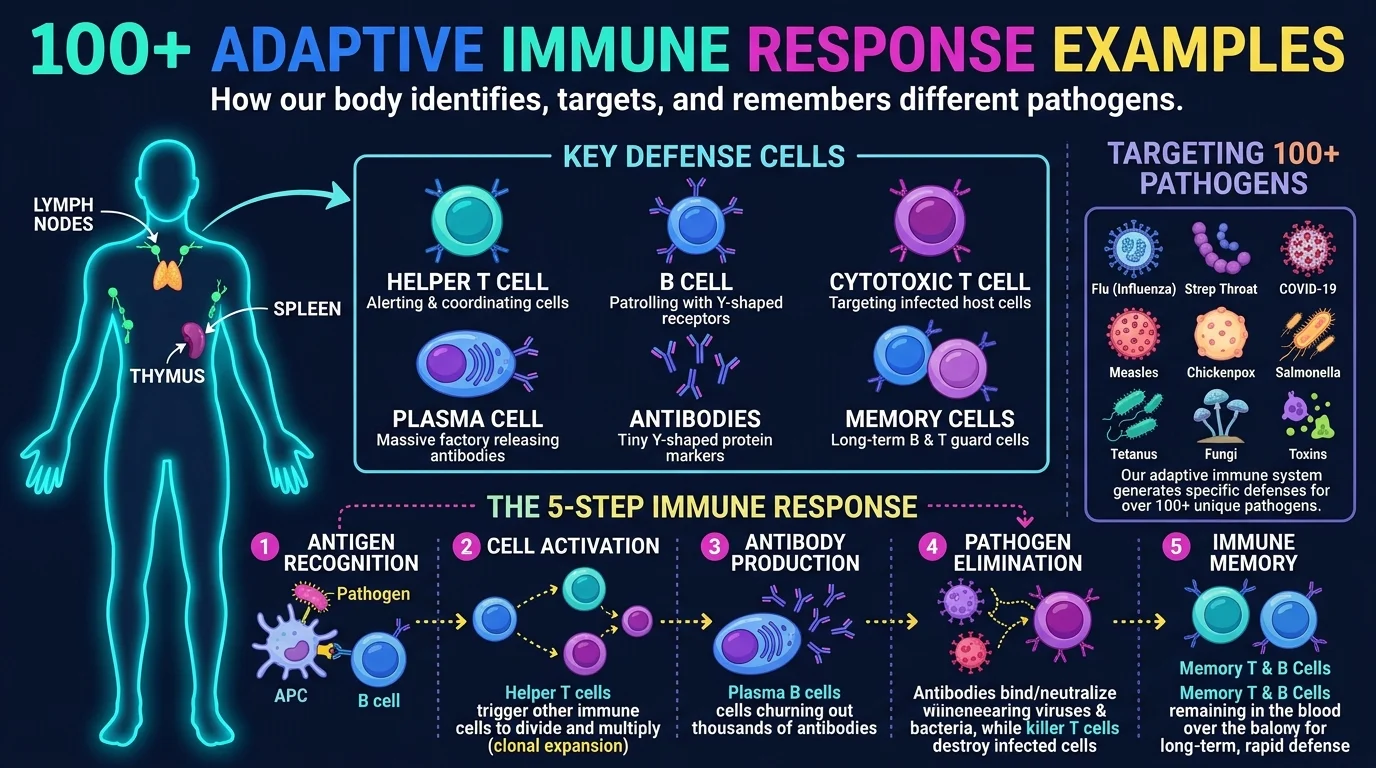
Your body has a pretty impressive security system. When a virus or bacterium shows up uninvited, your immune system gets to work identifying the intruder and figuring out how to fight it. But did you know your body can also remember certain germs and respond more effectively if they return?
That is where the adaptive immune response comes in. Whether you are studying biology, preparing for an exam, or simply curious about how vaccines protect you, understanding adaptive immune response examples makes this fascinating process much easier to grasp.
Antibody Production Examples
1. Antibodies Against a Virus
Example: Your immune system produces antibodies after recognizing a viral antigen.
Meaning: B cells develop into plasma cells that release antibodies targeting the virus.
2. Antibodies Against Bacteria
Example: Antibodies attach to bacteria and help immune cells recognize them.
Meaning: Antibodies support the body’s defense against specific bacterial invaders.
3. Antibodies After Vaccination
Example: A vaccine exposes your immune system to an antigen that triggers antibody production.
Meaning: Vaccination trains the adaptive immune system to recognize a particular threat.
4. Antibodies Against Tetanus Toxin
Example: After tetanus vaccination, your body can produce antibodies that neutralize the toxin.
Meaning: Specific antibodies can block harmful substances produced by pathogens.
5. Antibodies Against Influenza
Example: Your immune system produces antibodies against recognizable influenza virus antigens.
Meaning: These antibodies can help prevent or limit infection by matching viral targets.
6. Antibodies Against Measles
Example: Following measles vaccination, your body develops measles-specific antibodies.
Meaning: Antibody production contributes to protection against measles.
7. Antibodies Against Hepatitis B
Example: The hepatitis B vaccine stimulates the production of protective antibodies.
Meaning: The adaptive immune system learns to recognize a specific viral antigen.
8. Antibodies Against Chickenpox
Example: After vaccination or infection, your body can develop antibodies against the varicella-zoster virus.
Meaning: These antibodies contribute to immune protection against chickenpox.
9. Antibodies That Neutralize Viruses
Example: Antibodies bind to a virus and prevent it from entering a host cell.
Meaning: Neutralization blocks a critical step in infection.
10. Antibodies That Mark Pathogens
Example: Antibodies coat bacteria so immune cells can identify them more easily.
Meaning: This process, called opsonization, helps immune cells engulf pathogens.
11. Antibodies That Activate Complement
Example: Certain antibodies trigger the complement system after binding to a pathogen.
Meaning: Antibodies can help activate proteins that contribute to pathogen elimination.
12. Antibodies in Mucosal Secretions
Example: Secretory IgA antibodies help protect surfaces inside the nose and intestines.
Meaning: Specialized antibodies provide targeted defense at mucosal surfaces.
B-Cell Activation Examples
1. B Cells Recognizing an Antigen
Example: A B cell binds to a matching antigen on a pathogen.
Meaning: Specific antigen recognition can initiate a B-cell response.
2. B Cells Receiving Helper T-Cell Signals
Example: A helper T cell provides signals that activate an antigen-specific B cell.
Meaning: T-cell assistance helps coordinate many antibody responses.
3. B-Cell Clonal Expansion
Example: An activated B cell divides to produce many cells with the same antigen specificity.
Meaning: Clonal expansion increases the number of cells available to fight a particular threat.
4. B Cells Becoming Plasma Cells
Example: Activated B cells differentiate into antibody-secreting plasma cells.
Meaning: Plasma cells produce antibodies against the recognized antigen.
5. B Cells Becoming Memory Cells
Example: Some activated B cells become long-lived memory B cells.
Meaning: Memory B cells help the immune system respond to future encounters.
6. B Cells Responding to a Booster
Example: A booster vaccine activates B cells that recognize the vaccine antigen.
Meaning: A booster can strengthen an existing adaptive immune response.
7. B Cells Recognizing Bacterial Antigens
Example: A B cell binds to a specific antigen associated with a bacterium.
Meaning: B-cell recognition helps direct antibody production toward that target.
8. B Cells Responding to Viral Antigens
Example: B cells recognize proteins associated with a virus.
Meaning: Antigen recognition helps initiate a targeted antibody response.
9. B-Cell Affinity Maturation
Example: Some B cells develop receptors that bind an antigen more strongly.
Meaning: Affinity maturation can improve the quality of the antibody response.
10. B Cells Undergoing Class Switching
Example: An activated B cell switches from producing IgM to another antibody class.
Meaning: Class switching changes antibody function while preserving antigen specificity.
11. B Cells Responding in Lymph Nodes
Example: B cells encounter antigens and receive activation signals in a lymph node.
Meaning: Lymph nodes provide important locations for adaptive immune activation.
12. B Cells Forming Germinal Centers
Example: Activated B cells participate in germinal centers inside lymphoid tissues.
Meaning: Germinal centers support antibody refinement and memory B-cell development.
Helper T-Cell Response Examples
1. Activating B Cells
Example: A helper T cell recognizes an antigen presented by a B cell.
Meaning: Helper T cells provide signals that support antibody production.
2. Activating Macrophages
Example: A Th1 cell releases interferon-gamma that activates a macrophage.
Meaning: Helper T cells strengthen the ability of macrophages to destroy engulfed microbes.
3. Supporting Cytotoxic T Cells
Example: Helper T cells provide signals that support cytotoxic T-cell activation.
Meaning: Helper cells help coordinate cellular immune defenses.
4. Responding to Antigen Presentation
Example: A CD4 T cell recognizes a specific antigen displayed by an antigen-presenting cell.
Meaning: Antigen presentation helps activate antigen-specific helper T cells.
5. Releasing Cytokines
Example: Activated helper T cells release cytokines that influence other immune cells.
Meaning: Cytokines coordinate communication throughout the immune response.
6. Supporting Germinal Centers
Example: T follicular helper cells assist B cells inside germinal centers.
Meaning: These specialized helper cells support antibody maturation and selection.
7. Helping Fight Intracellular Bacteria
Example: Th1 cells help activate immune cells that control certain intracellular bacteria.
Meaning: Cell-mediated immunity is important against microbes living inside cells.
8. Supporting Antibody Class Switching
Example: Helper T-cell signals encourage B cells to produce particular antibody classes.
Meaning: T-cell assistance helps tailor the antibody response.
9. Recruiting Immune Cells
Example: Helper T-cell cytokines influence the movement and activity of other immune cells.
Meaning: Chemical signals help organize an effective response.
10. Supporting Immune Memory
Example: Some activated helper T cells develop into memory T cells.
Meaning: Memory helper cells can respond to a familiar antigen in the future.
11. Coordinating Multiple Defenses
Example: Helper T cells support both B-cell and cytotoxic T-cell responses.
Meaning: Helper cells connect different parts of adaptive immunity.
12. Responding to Vaccine Antigens
Example: Vaccine-specific helper T cells support the development of antibody responses.
Meaning: Helper T cells contribute to lasting vaccine-induced immunity.
Cytotoxic T-Cell Response Examples
1. Destroying Virus-Infected Cells
Example: A cytotoxic T cell recognizes a viral peptide displayed by an infected cell.
Meaning: It can kill the infected cell to limit viral replication.
2. Recognizing Antigens on MHC I
Example: A CD8 T cell recognizes a matching peptide presented by MHC class I.
Meaning: MHC I presentation helps cytotoxic T cells identify abnormal cells.
3. Releasing Perforin
Example: An activated cytotoxic T cell releases performing toward a target cell.
Meaning: Perforin helps deliver cell-killing proteins into the target.
4. Releasing Granzymes
Example: Granzymes enter a targeted cell and activate pathways that lead to cell death.
Meaning: These enzymes help eliminate infected or abnormal cells.
5. Triggering Apoptosis
Example: A cytotoxic T cell activates programmed cell death in a target cell.
Meaning: Apoptosis removes the targeted cell in a controlled way.
6. Responding to Influenza
Example: Cytotoxic T cells recognize influenza-derived peptides on infected respiratory cells.
Meaning: They can help remove cells producing the virus.
7. Responding to Certain Viral Infections
Example: CD8 T cells recognize infected cells displaying virus-specific peptides.
Meaning: Antigen-specific killing helps control viral infections.
8. Recognizing Abnormal Cells
Example: A cytotoxic T cell recognizes a cell displaying an abnormal antigen.
Meaning: T cells can contribute to immune surveillance against some abnormal cells.
9. Expanding After Activation
Example: An activated CD8 T cell divides into a larger population of specific T cells.
Meaning: Clonal expansion increases the number of cells targeting the antigen.
10. Developing Memory CD8 Cells
Example: Some activated cytotoxic T cells become long-lived memory cells.
Meaning: Memory CD8 cells can respond during a later encounter.
11. Recognizing Transplanted Tissue
Example: T cells recognize foreign tissue antigens after an organ transplant.
Meaning: Adaptive immunity can contribute to transplant rejection.
12. Responding to Cancer Antigens
Example: A cytotoxic T cell recognizes a tumor-associated antigen presented by a cancer cell.
Meaning: T cells can participate in immune responses against cancer.
Memory B-Cell Examples
1. Remembering a Vaccine Antigen
Example: Memory B cells remain after vaccination.
Meaning: They preserve the ability to recognize a previously encountered antigen.
2. Responding to a Booster Dose
Example: A booster reactivates memory B cells specific to the vaccine.
Meaning: Memory B cells can contribute to a faster antibody response.
3. Remembering Measles Antigens
Example: Measles vaccination can generate long-lived antigen-specific memory B cells.
Meaning: These cells contribute to lasting immune memory.
4. Remembering Tetanus Antigens
Example: Tetanus vaccination stimulates the formation of memory B cells.
Meaning: Memory helps the body respond to a later exposure to the same antigen.
5. Responding to a Familiar Virus
Example: Memory B cells recognize antigens from a virus encountered previously.
Meaning: Previous exposure can help the immune system respond more efficiently.
6. Producing New Plasma Cells
Example: Reactivated memory B cells develop into antibody-secreting cells.
Meaning: Memory B cells can replenish the antibody-producing population.
7. Expanding Rapidly
Example: Antigen recognition causes specific memory B cells to multiply.
Meaning: Expansion increases the number of cells available for defense.
8. Recognizing a Familiar Bacterial Antigen
Example: Memory B cells recognize an antigen associated with a previously encountered bacterium.
Meaning: Immune memory can help target a familiar bacterial threat.
9. Supporting High-Affinity Antibodies
Example: Memory B cells formed through a germinal-center response may produce high-affinity antibodies after reactivation.
Meaning: Previous immune responses can improve antigen recognition.
10. Contributing to Long-Term Protection
Example: Long-lived memory B cells persist after an infection has resolved.
Meaning: They provide a reserve of antigen-specific immune cells.
11. Responding to Repeat Exposure
Example: The same antigen activates memory B cells during a later exposure.
Meaning: The secondary response can begin more quickly than the primary response.
12. Working With Helper T Cells
Example: Memory B cells receive signals from antigen-specific helper T cells.
Meaning: T-cell help can support an effective secondary antibody response.
Memory T-Cell Examples
1. Remembering Viral Antigens
Example: Memory T cells remain after the body clears a viral infection.
Meaning: They preserve antigen-specific immune recognition.
2. Responding to Repeat Infection
Example: Memory T cells recognize a familiar antigen during a later infection.
Meaning: They can respond more rapidly than inexperienced T cells.
3. Memory CD8 T Cells
Example: Memory CD8 T cells recognize peptides from a previously encountered virus.
Meaning: They help prepare the body for a future encounter.
4. Memory CD4 T Cells
Example: Memory CD4 T cells recognize familiar antigens presented by immune cells.
Meaning: They can quickly provide helper functions during a later response.
5. Tissue-Resident Memory Cells
Example: Some memory T cells remain in tissues such as the skin or respiratory tract.
Meaning: They can provide localized immune surveillance.
6. Responding to Vaccine Antigens
Example: Vaccination produces memory T cells that recognize vaccine-related antigens.
Meaning: T-cell memory contributes to adaptive protection.
7. Releasing Cytokines Again
Example: Memory T cells release cytokines after recognizing a familiar antigen.
Meaning: They can rapidly coordinate immune activity.
8. Expanding After Re-exposure
Example: Antigen recognition stimulates memory T cells to divide.
Meaning: Expansion increases the number of antigen-specific cells.
9. Supporting B-Cell Responses
Example: Memory helper T cells assist B cells during a later encounter.
Meaning: T-cell memory can strengthen antibody production.
10. Responding to Intracellular Pathogens
Example: Memory T cells recognize antigens from a previously encountered intracellular pathogen.
Meaning: They can support cellular defenses against familiar threats.
11. Maintaining Tissue Surveillance
Example: Tissue-resident memory T cells remain positioned in previously exposed tissues.
Meaning: Their location can support a rapid local response.
12. Responding to a Booster
Example: A booster vaccine reactivates antigen-specific memory T cells.
Meaning: Re-exposure can reinforce established T-cell memory.
Primary Immune Response Examples
1. First Exposure to an Antigen
Example: A person encounters a new antigen for the first time.
Meaning: The adaptive immune system begins developing a specific response.
2. Initial Antibody Production
Example: B cells begin producing antibodies after activation.
Meaning: Antibody levels rise as the primary response develops.
3. Early IgM Production
Example: Activated B cells initially produce IgM during many primary responses.
Meaning: IgM is commonly an early antibody class in a new response.
4. Initial T-Cell Activation
Example: Naive T cells recognize antigens presented by immune cells.
Meaning: The body activates T cells specific to the newly encountered antigen.
5. Clonal Expansion
Example: Activated lymphocytes multiply after recognizing their matching antigen.
Meaning: The immune system increases the number of specific cells.
6. Developing Plasma Cells
Example: Activated B cells differentiate into plasma cells.
Meaning: These cells release antibodies during the developing response.
7. Developing Memory Cells
Example: Some activated B and T cells become memory cells.
Meaning: The primary response establishes the foundation for future immune memory.
8. A First Vaccine Dose
Example: A first vaccine dose introduces an antigen that activates adaptive immunity.
Meaning: The first dose can establish antigen-specific immune responses.
9. A First Encounter With a New Virus
Example: The immune system activates specific lymphocytes after encountering a previously unfamiliar virus.
Meaning: A primary response develops against the new antigen.
10. Antibody Levels Rising Over Time
Example: Antibody concentrations increase after immune activation.
Meaning: Antibody production takes time to build during a primary response.
11. Germinal-Center Formation
Example: Activated B cells form germinal centers in lymphoid tissues.
Meaning: These structures help refine antibody responses.
12. Establishing Immune Memory
Example: Some cells from the primary response persist after the infection ends.
Meaning: These cells help prepare the immune system for future exposure.
Secondary Immune Response Examples
1. Faster Antibody Production
Example: Antibody production increases after exposure to a familiar antigen.
Meaning: Memory cells help accelerate the secondary response.
2. A Vaccine Booster Response
Example: A booster stimulates immune cells primed by an earlier dose.
Meaning: Re-exposure can strengthen an existing adaptive response.
3. Higher Antibody Levels
Example: Antibody concentrations rise substantially after some booster vaccinations.
Meaning: A secondary response can produce more antibodies than the primary response.
4. High-Affinity Antibodies
Example: Memory B cells produce antibodies that bind a familiar antigen strongly.
Meaning: Previous immune selection can improve antibody affinity.
5. Rapid Memory B-Cell Activation
Example: Memory B cells recognize an antigen soon after re-exposure.
Meaning: Memory shortens the time needed to initiate a response.
6. Rapid Memory T-Cell Activation
Example: Memory T cells recognize a familiar antigen during a repeat infection.
Meaning: T-cell memory can accelerate cellular immunity.
7. Responding to a Familiar Bacterium
Example: Memory cells recognize an antigen from a previously encountered bacterium.
Meaning: Prior exposure can help the body respond more efficiently.
8. Responding to a Familiar Virus
Example: Memory lymphocytes recognize a viral antigen encountered before.
Meaning: The secondary response targets a known threat.
9. Stronger Response to a Booster
Example: A booster increases the number or activity of antigen-specific memory cells.
Meaning: Repeated exposure can reinforce immune protection.
10. Faster Plasma-Cell Formation
Example: Memory B cells rapidly differentiate into antibody-secreting cells.
Meaning: The body can increase antibody production sooner.
11. Reactivating Helper T Cells
Example: Memory helper T cells recognize a previously encountered antigen.
Meaning: They can quickly support other adaptive immune cells.
12. Reactivating Cytotoxic T Cells
Example: Memory CD8 T cells respond to familiar viral peptides.
Meaning: They can help eliminate infected cells during a repeat encounter.
Vaccine-Induced Adaptive Immunity Examples
1. Measles Vaccination
Example: The measles vaccine stimulates measles-specific B and T cells.
Meaning: Vaccination establishes targeted immune responses against measles.
2. Hepatitis B Vaccination
Example: The hepatitis B vaccine stimulates antibodies against hepatitis B surface antigen.
Meaning: Specific antibodies help protect against hepatitis B infection.
3. Tetanus Vaccination
Example: The tetanus vaccine stimulates antibodies that neutralize tetanus toxin.
Meaning: Vaccine-induced antibodies help protect against toxin-related disease.
4. Influenza Vaccination
Example: An influenza vaccine stimulates immune responses to selected influenza antigens.
Meaning: Vaccination prepares adaptive immunity to recognize targeted influenza strains.
5. Chickenpox Vaccination
Example: The varicella vaccine stimulates immunity against the virus that causes chickenpox.
Meaning: It helps establish antigen-specific immune protection.
6. Human Papillomavirus Vaccination
Example: HPV vaccination stimulates antibodies against targeted HPV types.
Meaning: These antibodies help prevent infection by covered HPV types.
7. Polio Vaccination
Example: Polio vaccination stimulates immune responses against poliovirus.
Meaning: Vaccine-induced immunity helps protect against polio.
8. COVID-19 Vaccination
Example: A COVID-19 vaccine stimulates adaptive responses against SARS-CoV-2 antigens.
Meaning: Vaccination can establish antibody and T-cell responses.
9. A Booster Dose
Example: A booster re-exposes the immune system to a vaccine antigen.
Meaning: It can reinforce existing immune memory.
10. Combination Vaccines
Example: A combination vaccine exposes the immune system to antigens from multiple pathogens.
Meaning: Adaptive immunity can develop responses to several targets.
11. Protein-Based Vaccines
Example: A protein-based vaccine introduces selected pathogen proteins.
Meaning: The immune system learns to recognize those antigens.
12. Vaccine Memory Cells
Example: Vaccination generates memory B cells and, depending on the vaccine, memory T cells.
Meaning: These cells help sustain immune readiness beyond the initial response.
Adaptive Immunity Against Viral Infections
1. Recognizing Viral Antigens
Example: B cells recognize a protein associated with a virus.
Meaning: Specific recognition helps initiate an adaptive response.
2. Producing Neutralizing Antibodies
Example: Antibodies bind a viral surface protein and block cell entry.
Meaning: Neutralization can prevent a virus from infecting susceptible cells.
3. Killing Infected Cells
Example: Cytotoxic T cells recognize viral peptides on infected cells.
Meaning: They help remove cells producing new viruses.
4. Activating Helper T Cells
Example: Viral antigens presented by immune cells activate specific helper T cells.
Meaning: Helper T cells coordinate other immune responses.
5. Forming Memory B Cells
Example: Viral infection generates antigen-specific memory B cells.
Meaning: Memory can support a future antibody response.
6. Forming Memory T Cells
Example: Some virus-specific T cells persist after infection.
Meaning: They preserve the capacity for a later cellular response.
7. Responding to Influenza
Example: Antibodies and T cells recognize influenza-related antigens.
Meaning: Multiple adaptive mechanisms can contribute to antiviral defense.
8. Responding to Measles
Example: Measles-specific antibodies and memory cells develop after vaccination or infection.
Meaning: Adaptive immunity can provide lasting protection.
9. Responding to Hepatitis B
Example: The immune system recognizes hepatitis B antigens and produces specific antibodies and T-cell responses.
Meaning: Adaptive immunity targets the virus and infected cells.
10. Responding to COVID-19
Example: Antibodies and T cells recognize SARS-CoV-2 antigens.
Meaning: Different adaptive immune mechanisms can contribute to protection.
11. Limiting Viral Spread
Example: Neutralizing antibodies prevent some viral particles from entering cells.
Meaning: Blocking cell entry can reduce the spread of infection.
12. Responding to Repeat Exposure
Example: Memory cells recognize a viral antigen encountered previously.
Meaning: Immune memory can accelerate a later response, although protection varies.
Adaptive Immunity Against Bacterial Infections
1. Antibodies Against Bacterial Surfaces
Example: B cells produce antibodies that bind bacterial surface antigens.
Meaning: Antibodies help the immune system recognize specific bacteria.
2. Opsonization
Example: Antibodies coat bacteria and help phagocytes identify them.
Meaning: Opsonization makes pathogens easier for immune cells to engulf.
3. Complement Activation
Example: Antibodies bound to bacteria activate parts of the complement system.
Meaning: Complement can support pathogen clearance.
4. Neutralizing Bacterial Toxins
Example: Antibodies bind a toxin produced by a bacterium.
Meaning: Neutralization can prevent the toxin from damaging cells.
5. Tetanus Protection
Example: Vaccine-induced antibodies bind tetanus toxin.
Meaning: Antitoxin antibodies help prevent toxin-mediated disease.
6. Diphtheria Protection
Example: Antibodies produced after vaccination neutralize diphtheria toxin.
Meaning: Adaptive immunity targets the harmful toxin.
7. Recognizing Bacterial Antigens
Example: B cells bind specific molecules found on a bacterium.
Meaning: Antigen recognition helps initiate a targeted response.
8. Activating Helper T Cells
Example: Bacterial antigens activate helper T cells through antigen presentation.
Meaning: Helper T cells coordinate immune activity.
9. Responding to Intracellular Bacteria
Example: Th1 cells activate macrophages that contain certain intracellular bacteria.
Meaning: Cell-mediated immunity helps control microbes inside cells.
10. Building Bacterial Immune Memory
Example: Some B and T cells persist after a bacterial infection.
Meaning: Memory cells can recognize related antigens in the future.
11. Responding to Repeat Exposure
Example: Memory B cells recognize a familiar bacterial antigen.
Meaning: Previous exposure can support a faster response.
12. Antibody-Mediated Protection
Example: Antibodies bind a bacterial antigen and support its removal.
Meaning: Humoral immunity is an important part of defense against many bacteria.
Antigen Recognition Examples
1. B-Cell Receptor Recognition
Example: A B-cell receptor binds a matching antigen.
Meaning: B cells can recognize specific antigen structures directly.
2. T-Cell Receptor Recognition
Example: A T-cell receptor recognizes a specific peptide displayed by an MHC molecule.
Meaning: T cells recognize antigens through peptide-MHC complexes.
3. MHC Class I Presentation
Example: A virus-infected cell displays a viral peptide on MHC class I.
Meaning: This presentation allows CD8 T cells to detect infected cells.
4. MHC Class II Presentation
Example: A dendritic cell displays a processed antigen on MHC class II.
Meaning: This presentation can activate CD4 helper T cells.
5. Dendritic Cell Antigen Presentation
Example: A dendritic cell presents pathogen-derived peptides to naive T cells.
Meaning: Dendritic cells help initiate adaptive immune responses.
6. Recognizing a Vaccine Antigen
Example: A B cell recognizes an antigen introduced by a vaccine.
Meaning: The recognition can initiate a vaccine-specific response.
7. Recognizing a Viral Protein
Example: An antibody binds a particular viral protein.
Meaning: The antibody recognizes a specific molecular target.
8. Recognizing a Bacterial Antigen
Example: A B-cell receptor binds a molecule associated with a bacterium.
Meaning: Specific recognition helps direct the response toward that bacterium.
9. Recognizing a Foreign Tissue Antigen
Example: T cells recognize foreign molecules associated with transplanted tissue.
Meaning: Adaptive immunity can distinguish some transplanted tissues as foreign.
10. Recognizing Tumor-Associated Antigens
Example: A T cell recognizes a tumor-associated peptide presented by MHC.
Meaning: Antigen recognition can contribute to immune responses against cancer.
11. Recognizing an Allergen
Example: Allergen-specific B cells produce IgE antibodies.
Meaning: Adaptive immunity can also contribute to allergic reactions.
12. Recognizing a Familiar Antigen
Example: A memory lymphocyte recognizes an antigen encountered previously.
Meaning: Immune memory preserves antigen-specific recognition.
Immune Memory and Long-Term Protection Examples
1. Long-Lived Plasma Cells
Example: Some plasma cells survive for years and continue producing antibodies.
Meaning: Long-lived plasma cells can maintain antibody levels over time.
2. Persistent Memory B Cells
Example: Memory B cells remain after an infection or vaccination.
Meaning: They preserve the capacity to respond to familiar antigens.
3. Persistent Memory T Cells
Example: Memory T cells survive after the initial immune response.
Meaning: They support future antigen-specific responses.
4. Measles Immune Memory
Example: Measles vaccination generates long-lasting immune memory in many people.
Meaning: Immune memory contributes to sustained protection.
5. Tetanus Immune Memory
Example: Tetanus vaccination establishes memory, with booster doses used to maintain protection.
Meaning: Immune memory can persist, but protection may require boosters.
6. Hepatitis B Immune Memory
Example: Hepatitis B vaccination can establish immune memory.
Meaning: Memory helps maintain protection even as measurable antibody levels change.
7. Memory After Infection
Example: Some antigen-specific lymphocytes remain after an infection resolves.
Meaning: The immune system retains information about the earlier encounter.
8. Faster Secondary Responses
Example: Memory cells activate after re-exposure to a familiar antigen.
Meaning: The secondary response can develop faster than the primary response.
9. Antibody Persistence
Example: Long-lived plasma cells continue secreting antibodies after an infection.
Meaning: Persistent antibodies can provide ongoing protection.
10. Tissue-Resident Memory
Example: Memory T cells remain in tissues previously exposed to a pathogen.
Meaning: Their location can support rapid local responses.
11. Memory After a Booster
Example: A booster activates and expands antigen-specific memory cells.
Meaning: Repeat vaccination can reinforce existing immune memory.
12. Protection Against Familiar Antigens
Example: Memory cells recognize an antigen from a previous infection.
Meaning: Prior exposure can improve the speed and effectiveness of a later response.
Adaptive Immune Response in Everyday Medical Examples
1. Recovering From Chickenpox
Example: After chickenpox, the immune system develops antibodies and memory cells against the virus.
Meaning: Infection can establish adaptive immune memory.
2. Receiving a Flu Vaccine
Example: A flu vaccine stimulates responses against selected influenza antigens.
Meaning: Vaccination prepares the immune system to recognize targeted strains.
3. Getting a Tetanus Booster
Example: A booster reactivates immunity against tetanus toxin.
Meaning: Booster vaccination helps maintain protective antibody levels.
4. Receiving an HPV Vaccine
Example: HPV vaccination stimulates antibodies against targeted human papillomavirus types.
Meaning: Adaptive immunity helps prevent infection by covered types.
5. Responding to a Hepatitis B Vaccine
Example: The vaccine stimulates antibodies against hepatitis B surface antigen.
Meaning: Specific antibodies contribute to protection against hepatitis B.
6. Recovering From a Viral Illness
Example: Antigen-specific B and T cells respond during infection.
Meaning: Adaptive immunity contributes to controlling and clearing many viral infections.
7. Developing a Vaccine Response
Example: A vaccine activates antigen-specific lymphocytes.
Meaning: The body develops targeted defenses without needing to experience the disease itself in its natural form.
8. Receiving a Booster After Several Years
Example: A booster reintroduces an antigen to an immune system with existing memory.
Meaning: A booster can renew or strengthen a response.
9. Producing Antibodies After Infection
Example: B cells become plasma cells and release antibodies against the pathogen.
Meaning: Antibody production is a central part of humoral immunity.
10. Detecting a Repeat Infection
Example: Memory cells recognize antigens from a previous infection.
Meaning: Immune memory can help the body respond to familiar pathogens.
11. Responding to a New Pathogen
Example: Naive B and T cells recognize newly encountered antigens.
Meaning: Adaptive immunity can develop responses to previously unfamiliar threats.
12. Responding to a Transplant
Example: T cells recognize foreign antigens on transplanted tissue.
Meaning: Adaptive immunity can contribute to transplant rejection and requires careful medical management.
Adaptive Immune Response Examples in Simple Terms
1. Your Body Makes Specific Antibodies
Example: After vaccination, your body produces antibodies against a particular antigen.
Meaning: Adaptive immunity creates targeted molecular defenses.
2. Your Immune System Remembers a Germ
Example: Memory cells remain after an infection.
Meaning: The body retains information about a previous immune challenge.
3. B Cells Become Antibody Factories
Example: Activated B cells develop into plasma cells.
Meaning: Plasma cells release antibodies that bind specific antigens.
4. T Cells Destroy Infected Cells
Example: Cytotoxic T cells recognize and kill certain virus-infected cells.
Meaning: Cellular immunity helps remove infected cells.
5. Helper T Cells Coordinate Defenses
Example: Helper T cells release signals that support B cells and other immune cells.
Meaning: They help organize the adaptive immune response.
6. A Booster Strengthens Immune Memory
Example: A booster reactivates antigen-specific memory cells.
Meaning: Repeat vaccination can reinforce existing immunity.
7. Antibodies Block a Virus
Example: Neutralizing antibodies prevent a virus from entering a host cell.
Meaning: Antibodies can interfere with infection.
8. Immune Cells Multiply
Example: Activated lymphocytes divide after recognizing a specific antigen.
Meaning: Clonal expansion increases the number of targeted immune cells.
9. Your Body Responds Faster the Second Time
Example: Memory cells recognize an antigen from a previous encounter.
Meaning: The secondary response can begin more rapidly.
10. A Vaccine Trains Your Immune System
Example: A vaccine exposes the immune system to selected antigens.
Meaning: Vaccination can establish antigen-specific protection and memory.
11. Antibodies Help Tag Bacteria
Example: Antibodies coat bacteria so phagocytes can recognize them.
Meaning: Antibodies help other immune cells identify pathogens.
12. Memory Cells Prepare for the Future
Example: Some B and T cells persist after the initial response.
Meaning: These cells help the immune system prepare for future encounters with familiar antigens.
FAQs
What does adaptive immune response mean?
The adaptive immune response is the part of the immune system that recognizes specific antigens and develops targeted defenses using B cells, T cells, antibodies, and immune memory.
What are three examples of adaptive immunity?
Three examples are antibody production after vaccination, cytotoxic T cells killing virus-infected cells, and memory B cells responding to a familiar antigen.
Is antibody production an example of adaptive immunity?
Yes. Antibodies are produced by plasma cells that develop from activated B cells, making antibody production a central part of adaptive immunity.
Is the adaptive immune response responsible for immune memory?
Yes. Memory B cells and memory T cells can persist after an initial immune response and help the body respond to familiar antigens later.
What is the difference between innate and adaptive immunity?
Innate immunity provides rapid, broad defense. Adaptive immunity recognizes specific antigens and can develop lasting immune memory.
How do vaccines produce an adaptive immune response?
Vaccines expose the immune system to selected antigens or instructions for producing them. This can activate B and T cells and establish immune memory.
What is an example of a cell-mediated immune response?
A cytotoxic T cell recognizing and killing a virus-infected cell is an example of cell-mediated adaptive immunity.
What is an example of humoral immunity?
A B cell developing into a plasma cell and producing antibodies against a pathogen is an example of humoral immunity.
Why is the secondary immune response faster?
Memory B and T cells can recognize familiar antigens and respond more quickly than naive cells encountering an antigen for the first time.
Can adaptive immunity cause allergies?
Yes. In some allergic reactions, adaptive immunity produces allergen-specific IgE antibodies, which can trigger inflammatory responses.
Conclusion
Adaptive immune response examples show how your body builds targeted defenses against specific threats. From producing antibodies and activating T cells to creating long-lasting immune memory, each process plays a role in protecting you from infections.