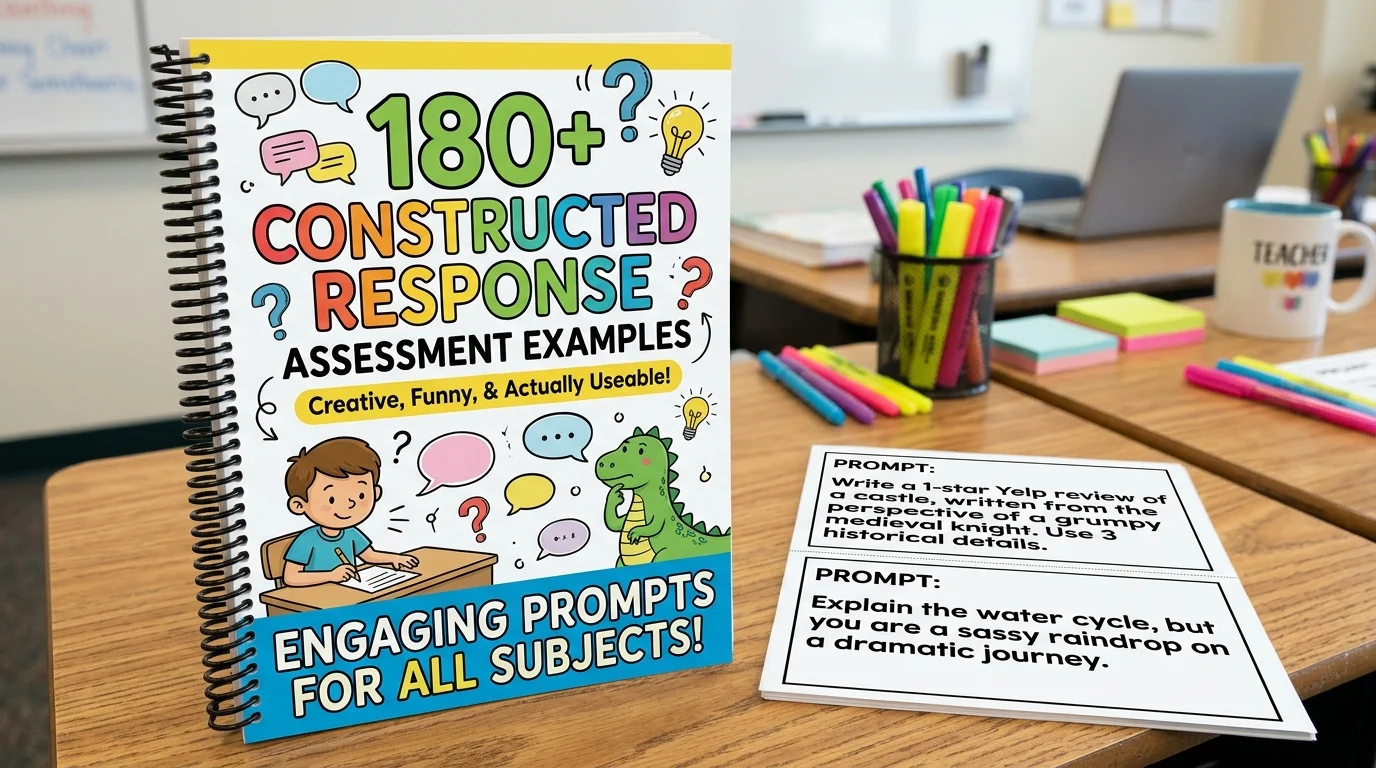
A Constructed Response Assessment is a type of test that asks students to create their own answers instead of choosing from multiple-choice options. It allows students to explain their ideas, show what they understand, and demonstrate their knowledge in their own words. These assessments may include short-answer questions, written explanations, problem-solving tasks, and extended responses.Unlike selected-response tests, which provide ready-made answer choices, constructed response assessments require students to think critically and organize their thoughts. Teachers use them to evaluate not only what students know but also how well they can apply, explain, and support their answers.
Constructed Response Assessment Funny Examples
Explain the main idea like you are telling a friend who missed class.
Use this when you want students to demonstrate understanding without sounding overly formal.
Meaning: This prompt encourages students to explain the central concept in simple language.
Describe the character’s biggest problem without making it sound like a soap opera.
Use this for literature activities with students who enjoy playful wording.
Meaning: This asks students to identify and explain the character’s main conflict.
Explain why the experiment worked, failed, or decided to become dramatic.
Use this after a science experiment with an engaging classroom tone.
Meaning: Students must explain the results using scientific reasoning.
Summarize the lesson in three sentences and pretend your attention span is on vacation.
Use this for quick comprehension checks.
Meaning: Students must identify and communicate the most important information concisely.
What caused the problem, and how do you know? Detective hat optional.
Use this when assessing cause-and-effect reasoning.
Meaning: Students need to identify a cause and support their answer with evidence.
Explain the math strategy without making your calculator do all the talking.
Use this when you want students to show their mathematical process.
Meaning: Students must explain how they reached their answer.
Describe the historical event as if you had to explain it during lunch.
Use this for informal history review.
Meaning: Students demonstrate historical understanding using accessible language.
What would happen next, and why? Make your prediction count.
Use this after reading part of a story or analyzing a scientific process.
Meaning: Students make a prediction and support it logically.
Explain the biggest lesson without turning your answer into a textbook.
Use this for reflective comprehension questions.
Meaning: Students identify the key takeaway in their own words.
What is the author trying to say, and what makes you think that?
Use this when teaching interpretation and evidence.
Meaning: Students identify the author’s message and justify their interpretation.
Describe the solution that would save the day academically.
Use this for problem-solving activities.
Meaning: Students propose and explain a reasonable solution.
Explain your answer like you actually want someone to understand it.
Use this when students tend to provide unsupported answers.
Meaning: The prompt emphasizes clarity, reasoning, and explanation.
Brutally Honest Constructed Response Assessment Examples
What is the strongest evidence supporting your answer?
Use this when students need to move beyond unsupported opinions.
Meaning: Students must identify concrete evidence that validates their response.
Explain exactly how you reached your conclusion.
Use this for reasoning-based assessments.
Meaning: Students reveal the logical steps behind their conclusion.
What part of your answer could someone challenge, and why?
Use this for advanced critical-thinking activities.
Meaning: Students evaluate weaknesses or limitations in their own reasoning.
Which detail matters most, and what makes it important?
Use this when assessing the ability to prioritize information.
Meaning: Students identify the most significant detail and explain its relevance.
What evidence would change your answer?
Use this for analytical discussions and assessments.
Meaning: Students consider how additional evidence could affect their conclusion.
What mistake would be easiest to make here? Explain why.
Use this when reviewing common misconceptions.
Meaning: Students identify a likely error and explain its cause.
Which argument is weakest, and what evidence exposes the weakness?
Use this for argument analysis.
Meaning: Students evaluate claims and identify insufficient support.
What does the evidence actually prove?
Use this when students confuse evidence with assumptions.
Meaning: Students distinguish supported conclusions from unsupported claims.
What information is missing from this problem?
Use this for higher-level problem analysis.
Meaning: Students identify gaps that prevent a complete conclusion.
What would you change about this solution? Explain your reasoning.
Use this for revision and evaluation tasks.
Meaning: Students critique an existing solution and propose an improvement.
Why is your answer more reasonable than another possible answer?
Use this for comparative reasoning.
Meaning: Students defend their conclusion by comparing alternatives.
What is the clearest reason your answer makes sense?
Use this for short constructed responses.
Meaning: Students provide their strongest justification without unnecessary detail.
Flirty Constructed Response Assessment Examples
Explain your answer like you are trying to impress the person grading it.
Use this for a playful classroom challenge when students are comfortable with humor.
Meaning: The prompt encourages polished and confident explanation.
What evidence supports your conclusion, and yes, confidence counts too.
Use this for a lighthearted evidence-based activity.
Meaning: Students must support their conclusions while presenting them confidently.
Make your explanation so clear nobody needs a second look.
Use this for writing practice.
Meaning: Students focus on clarity and precision.
Give your best explanation, but keep the academic charm.
Use this for a fun writing warm-up.
Meaning: Students practice expressing ideas clearly with personality.
Explain the concept like you are making a very convincing first impression.
Use this when introducing persuasive communication.
Meaning: Students learn to present information in an engaging way.
What makes your answer stand out from the crowd?
Use this when encouraging original thinking.
Meaning: Students explain what makes their reasoning distinctive.
Show me the evidence, and make it convincing.
Use this for argument-based questions.
Meaning: Students must provide relevant evidence and connect it to their claim.
Explain your reasoning with confidence, not confusion.
Use this for response-writing practice.
Meaning: Students are encouraged to communicate their thinking directly.
What detail makes your answer especially convincing?
Use this for evidence analysis.
Meaning: Students identify the strongest supporting detail.
Turn your explanation into something worth reading.
Use this for writing assignments where engagement matters.
Meaning: Students are encouraged to make their explanation clear and interesting.
Why should someone believe your answer?
Use this for persuasive response practice.
Meaning: Students must justify their answer with logical support.
Give the answer some personality while keeping the evidence strong.
Use this for creative academic writing.
Meaning: Students combine engaging language with accurate reasoning.
Polite Constructed Response Assessment Examples
Explain your answer and include evidence to support your thinking.
Use this for standard classroom assessments.
Meaning: Students provide an answer and support it with relevant evidence.
Please describe how you reached your conclusion.
Use this when assessing reasoning skills.
Meaning: Students explain the process behind their conclusion.
What information supports your response?
Use this for reading and research assessments.
Meaning: Students identify information that strengthens their answer.
Please compare the two ideas and explain one important difference.
Use this for comparison tasks.
Meaning: Students identify and explain a meaningful distinction.
How would you explain this concept in your own words?
Use this to check genuine understanding.
Meaning: Students demonstrate comprehension without copying a definition.
What is the most important point you learned?
Use this for lesson reflections.
Meaning: Students identify the main takeaway from the material.
Why do you think this result occurred?
Use this for science, history, or analytical questions.
Meaning: Students provide a reasoned explanation for an outcome.
What evidence helped you reach your answer?
Use this for evidence-based assessments.
Meaning: Students connect their conclusion to supporting information.
How would you improve this solution?
Use this for evaluation activities.
Meaning: Students identify practical improvements to an existing solution.
What alternative explanation could also make sense?
Use this for advanced reasoning.
Meaning: Students consider another plausible interpretation.
What connection can you make between these ideas?
Use this for conceptual learning.
Meaning: Students explain how two or more concepts relate.
Could you summarize your reasoning in two or three sentences?
Use this for concise written responses.
Meaning: Students communicate their thinking clearly and efficiently.
Professional Constructed Response Assessment Examples
Analyze the evidence and explain the conclusion it supports.
Use this for formal academic assessments.
Meaning: Students connect evidence to a defensible conclusion.
Evaluate the effectiveness of the proposed solution.
Use this for analytical assignments.
Meaning: Students judge how well a solution addresses a specific problem.
Explain the relationship between the two concepts.
Use this for conceptual assessments.
Meaning: Students identify and explain how two ideas interact.
Identify the primary cause and support your response with evidence.
Use this for cause-and-effect analysis.
Meaning: Students identify a main cause and justify it.
Compare the two perspectives and explain their most significant difference.
Use this for social studies and literature.
Meaning: Students analyze similarities and differences between viewpoints.
Interpret the data and describe the conclusion you can reasonably draw.
Use this for science or data-based assessments.
Meaning: Students interpret information and form a supported conclusion.
Explain why the evidence is relevant to the claim.
Use this for argument analysis.
Meaning: Students explain the connection between evidence and a claim.
Assess the strengths and limitations of the proposed approach.
Use this for advanced evaluation tasks.
Meaning: Students consider both benefits and weaknesses.
Describe the process that led to the observed outcome.
Use this for process-based learning.
Meaning: Students explain the sequence or mechanism behind an outcome.
Provide a reasoned response based on the information provided.
Use this for formal written assessments.
Meaning: Students develop an answer using available evidence.
Explain which factor had the greatest influence and why.
Use this for analytical comparisons.
Meaning: Students identify the most influential factor and justify their choice.
Support your conclusion with at least two relevant details.
Use this for structured response questions.
Meaning: Students provide multiple pieces of evidence to strengthen their answer.
Creative Constructed Response Assessment Examples
Imagine you are teaching this concept to someone who has never heard of it.
Use this for comprehension checks.
Meaning: Students translate complex information into understandable language.
Create a real-world example that demonstrates the concept.
Use this for application-based learning.
Meaning: Students show understanding by connecting theory to reality.
Describe what would happen if one important factor changed.
Use this for prediction activities.
Meaning: Students explore how changing a variable affects an outcome.
Explain the lesson through a short story or scenario.
Use this for creative comprehension tasks.
Meaning: Students demonstrate understanding through storytelling.
Invent a practical solution to the problem and explain why it would work.
Use this for problem-solving activities.
Meaning: Students create and justify an original solution.
Describe the concept using an everyday comparison.
Use this when abstract ideas need clarification.
Meaning: Students connect an academic idea to something familiar.
Create an example that proves you understand the main idea.
Use this for comprehension assessments.
Meaning: Students demonstrate understanding through an original example.
Imagine the outcome if the main rule did not exist.
Use this for critical-thinking exercises.
Meaning: Students explore the importance of a rule by imagining its absence.
Design a solution and explain the thinking behind it.
Use this for project-based learning.
Meaning: Students combine creativity with analytical reasoning.
Explain the topic using a metaphor that actually makes sense.
Use this for conceptual learning.
Meaning: Students use comparison to clarify an abstract concept.
Create a different ending and explain how it changes the message.
Use this for literature activities.
Meaning: Students explore how changes affect meaning and interpretation.
Turn the key idea into a real-life scenario and explain the connection.
Use this for application tasks.
Meaning: Students demonstrate how classroom knowledge applies outside school.
Sarcastic Constructed Response Assessment Examples
Explain your answer, because apparently the evidence cannot speak for itself.
Use this when adding playful energy to an evidence-based task.
Meaning: Students are reminded to explain and support their answer.
Show your work, because guessing is not a personality trait.
Use this for mathematics or reasoning assessments.
Meaning: Students must demonstrate the process behind their answer.
Explain the main idea before it disappears into the academic void.
Use this for quick reading checks.
Meaning: Students identify the central point clearly.
What evidence supports your answer, besides pure confidence?
Use this for argument analysis.
Meaning: Students learn that confidence alone does not establish validity.
Explain why your solution works instead of simply announcing victory.
Use this for problem-solving activities.
Meaning: Students justify their proposed solution.
Tell us what happened and, ideally, why it happened.
Use this for cause-and-effect questions.
Meaning: Students explain both the event and its cause.
Give us the reasoning, not just the answer wearing sunglasses.
Use this for math and science assessments.
Meaning: Students provide reasoning rather than only stating a conclusion.
Which detail actually matters here? Choose wisely.
Use this for prioritization tasks.
Meaning: Students identify the most relevant information.
What makes your answer believable? Evidence would be a lovely start.
Use this for written arguments.
Meaning: Students support their answer with credible evidence.
Explain the mistake before it starts a sequel.
Use this for misconception activities.
Meaning: Students identify why an incorrect approach fails.
What changed, and why should anyone care?
Use this for historical or scientific analysis.
Meaning: Students identify a change and explain its significance.
Defend your answer without declaring yourself the winner.
Use this for respectful argumentation.
Meaning: Students justify their conclusion using reasoning rather than unsupported confidence.
Cute Constructed Response Assessment Examples
Explain the idea in your own words.
Use this for friendly comprehension checks.
Meaning: Students show understanding using language they naturally understand.
What is one thing about this topic that surprised you?
Use this for reflective assessments.
Meaning: Students identify a surprising or memorable aspect of the lesson.
Tell us the most important little detail.
Use this for close-reading activities.
Meaning: Students identify a small but meaningful piece of information.
What connection made the idea click for you?
Use this for reflection questions.
Meaning: Students explain what helped them understand the concept.
Give one example that makes the idea easy to understand.
Use this for conceptual learning.
Meaning: Students clarify a concept through an example.
What would you tell a friend about this lesson?
Use this for informal comprehension checks.
Meaning: Students summarize the lesson in accessible language.
Which part deserves a little gold star, and why?
Use this for identifying important evidence or ideas.
Meaning: Students explain which element they consider most significant.
Explain the answer in the simplest way you can.
Use this for foundational learners.
Meaning: Students focus on clarity instead of complicated wording.
What little clue helped you find the answer?
Use this for reading or problem-solving tasks.
Meaning: Students identify evidence that guided their reasoning.
What did this example help you understand?
Use this after demonstrations or models.
Meaning: Students connect an example to a broader concept.
What is one useful thing you can take from this lesson?
Use this for reflective learning.
Meaning: Students identify a practical takeaway.
Explain your thinking in a way that helps someone else learn.
Use this for peer-learning activities.
Meaning: Students communicate their understanding clearly enough to teach another person.
Dramatic Constructed Response Assessment Examples
Explain what caused the turning point and why it mattered.
Use this for literature or historical analysis.
Meaning: Students identify a major turning point and explain its significance.
What decision changed everything, and what happened because of it?
Use this for narrative or historical assessments.
Meaning: Students analyze an important decision and its consequences.
Describe the biggest conflict and explain what was at stake.
Use this for story analysis.
Meaning: Students identify the central conflict and its consequences.
What moment had the greatest impact on the outcome?
Use this for sequence analysis.
Meaning: Students identify and justify the most influential event.
Explain how one small detail created a much bigger result.
Use this for cause-and-effect activities.
Meaning: Students analyze how a minor factor can influence a larger outcome.
What would have happened if the key decision had gone differently?
Use this for historical or literary analysis.
Meaning: Students explore an alternative outcome using logical reasoning.
Identify the moment when everything changed.
Use this for narrative analysis.
Meaning: Students locate the pivotal point in an event or story.
What conflict drives the entire situation?
Use this for literature and social studies.
Meaning: Students identify the central source of tension.
Explain why the final outcome was significant.
Use this for conclusion analysis.
Meaning: Students explain the importance of the ending or result.
Which event deserves the spotlight, and why?
Use this for historical or narrative review.
Meaning: Students identify the most important event and justify it.
How did the situation build toward its final outcome?
Use this for sequence and causation tasks.
Meaning: Students explain how earlier events contributed to the ending.
What lesson can be learned from the outcome?
Use this for reflective analysis.
Meaning: Students identify a broader lesson based on what happened.
Chill And Casual Constructed Response Examples
Explain it like you would explain it to a friend.
Use this for informal comprehension checks.
Meaning: Students translate academic information into everyday language.
What is the main thing we need to know?
Use this for quick review activities.
Meaning: Students identify the most important takeaway.
Why does this matter in real life?
Use this for practical application.
Meaning: Students connect classroom learning to everyday situations.
What made this answer make sense to you?
Use this for reflection.
Meaning: Students identify the reasoning or evidence that helped them understand.
Give one example that makes this easier to get.
Use this when students need to demonstrate understanding.
Meaning: Students clarify the concept through an example.
What happened, and what caused it?
Use this for basic cause-and-effect assessment.
Meaning: Students identify both an event and its cause.
Which idea stands out the most?
Use this for lesson review.
Meaning: Students select and explain an important idea.
How would you explain this without using complicated words?
Use this for language-focused assessments.
Meaning: Students demonstrate understanding using simple language.
What is the easiest way to understand this concept?
Use this for conceptual learning.
Meaning: Students identify a clear explanation or useful perspective.
What would you do differently in this situation?
Use this for application and reflection.
Meaning: Students propose an alternative action and explain it.
What is one detail you would definitely remember?
Use this for memory and comprehension checks.
Meaning: Students identify a memorable and meaningful detail.
Give the short version, then explain why it works.
Use this for concise analytical responses.
Meaning: Students provide a direct answer followed by reasoning.
Confident Constructed Response Examples
State your answer clearly, then prove it with evidence.
Use this for argument-based assessments.
Meaning: Students combine a clear claim with supporting evidence.
What is your conclusion, and what supports it?
Use this for analytical writing.
Meaning: Students state a conclusion and identify evidence.
Choose the strongest explanation and defend your choice.
Use this for comparison questions.
Meaning: Students select an explanation and justify why it is strongest.
Explain why your interpretation is reasonable.
Use this for literature or evidence analysis.
Meaning: Students support an interpretation with logical reasoning.
Identify the most important factor and justify your decision.
Use this for analytical assessments.
Meaning: Students prioritize one factor and explain their reasoning.
What evidence makes your conclusion convincing?
Use this for evidence-based responses.
Meaning: Students identify evidence that strengthens their claim.
Take a position and support it with two details.
Use this for persuasive writing practice.
Meaning: Students make a clear claim and provide support.
Which answer best fits the evidence, and why?
Use this for interpretation tasks.
Meaning: Students select the most evidence-supported conclusion.
Explain what you know and how you know it.
Use this for metacognitive assessment.
Meaning: Students describe both their understanding and its basis.
What is the strongest reason behind your answer?
Use this for short responses.
Meaning: Students identify their most persuasive justification.
Defend your conclusion using specific evidence.
Use this for formal argument tasks.
Meaning: Students support their conclusion with relevant details.
Explain your reasoning without second-guessing every sentence.
Use this for confidence-building writing activities.
Meaning: Students practice expressing a well-supported idea directly.
Emotional Constructed Response Examples
How did this event affect the people involved?
Use this for literature, history, or social studies assessments.
Meaning: Students analyze emotional or human consequences.
Why do you think this moment was meaningful?
Use this for reflective reading activities.
Meaning: Students explain the significance of an important moment.
What emotions does the situation create, and what causes them?
Use this for character or narrative analysis.
Meaning: Students connect emotions to specific events or details.
How might someone in this situation feel, and why?
Use this for perspective-taking exercises.
Meaning: Students infer emotions using contextual evidence.
What does this experience teach us about people?
Use this for literature or social studies reflection.
Meaning: Students connect an event to a broader human lesson.
Which moment carries the strongest emotional impact?
Use this for narrative analysis.
Meaning: Students identify and explain an emotionally significant moment.
How does the author’s language influence the reader’s feelings?
Use this for literary analysis.
Meaning: Students examine how word choice affects emotional response.
Why might this decision have been difficult?
Use this for character or historical analysis.
Meaning: Students explore the factors that could make a decision challenging.
What human experience does this example represent?
Use this for thematic analysis.
Meaning: Students connect a specific example to a broader human experience.
How does the ending change your understanding of the situation?
Use this for story analysis.
Meaning: Students explain how the conclusion affects interpretation.
What detail makes the situation feel most important?
Use this for close reading.
Meaning: Students identify a detail that increases emotional or thematic significance.
What lesson feels most meaningful, and why?
Use this for reflective assessments.
Meaning: Students identify a meaningful lesson and explain its importance.
Sweet Constructed Response Examples
Explain the idea in a way that would help someone else understand it.
Use this for peer-learning exercises.
Meaning: Students demonstrate understanding through clear explanation.
What is one positive lesson from this example?
Use this for reflection activities.
Meaning: Students identify a constructive takeaway.
How does this example show why the concept matters?
Use this for application-based assessment.
Meaning: Students connect an example to the importance of a concept.
What makes this solution helpful?
Use this for problem-solving activities.
Meaning: Students identify the useful qualities of a solution.
Explain one way this knowledge could help someone in real life.
Use this for practical learning.
Meaning: Students connect academic knowledge to real-world benefits.
What can we learn from the way this problem was handled?
Use this for case-study assessments.
Meaning: Students identify lessons from an approach or decision.
Which detail makes the explanation easier to understand?
Use this for communication-focused activities.
Meaning: Students identify an especially clear or useful detail.
How could this idea help someone solve a similar problem?
Use this for transfer-of-learning questions.
Meaning: Students apply knowledge to another situation.
What is one thoughtful conclusion you can draw?
Use this for reflective analysis.
Meaning: Students develop a reasoned conclusion from the available information.
How would you teach this idea to a classmate?
Use this for comprehension assessment.
Meaning: Students demonstrate mastery by explaining the idea to someone else.
What makes this example memorable?
Use this for review activities.
Meaning: Students identify a feature that helps the concept stick.
What is the most useful thing to remember from this lesson?
Use this for lesson reflection.
Meaning: Students identify the key practical takeaway.
Clever Constructed Response Examples
What clue gives away the best answer?
Use this for evidence-based reading or problem-solving tasks.
Meaning: Students identify information that points toward the correct conclusion.
What is the hidden connection between these ideas?
Use this for advanced conceptual analysis.
Meaning: Students identify a less obvious relationship between concepts.
Which detail changes the way we should interpret the situation?
Use this for close reading.
Meaning: Students identify information that affects interpretation.
What assumption is hiding behind this argument?
Use this for critical-thinking exercises.
Meaning: Students identify an unstated belief supporting an argument.
What pattern do you notice, and what might it mean?
Use this for data or text analysis.
Meaning: Students identify a pattern and interpret its significance.
Which piece of evidence does the most work?
Use this for argument analysis.
Meaning: Students identify the most influential supporting evidence.
What would you need to know before making a final judgment?
Use this for inquiry-based assessment.
Meaning: Students identify missing information needed for a reliable conclusion.
What is the strongest connection you can make?
Use this for synthesis activities.
Meaning: Students connect ideas using meaningful reasoning.
What alternative explanation fits the evidence?
Use this for advanced analytical tasks.
Meaning: Students consider another explanation that remains consistent with the evidence.
What detail would be easiest to overlook?
Use this for close-reading exercises.
Meaning: Students identify subtle but potentially important information.
How does changing one assumption change the conclusion?
Use this for reasoning activities.
Meaning: Students examine how assumptions influence conclusions.
What question should we ask next?
Use this for inquiry-based learning.
Meaning: Students identify a useful next step for deeper investigation.
Academic Constructed Response Assessment Examples
Explain the central concept using evidence from the material.
Use this for standard academic assessments.
Meaning: Students demonstrate understanding and support it with evidence.
Compare two concepts and explain their similarities and differences.
Use this for comparison assessments.
Meaning: Students analyze both shared and distinct characteristics.
Describe the process and explain why each major step matters.
Use this for science or procedural learning.
Meaning: Students explain both sequence and significance.
Analyze the evidence and formulate a supported conclusion.
Use this for higher-level assessments.
Meaning: Students interpret evidence and develop a defensible conclusion.
Explain the author’s main argument and identify supporting evidence.
Use this for reading assessments.
Meaning: Students identify a central claim and the evidence supporting it.
Describe one cause and one effect related to the topic.
Use this for foundational analysis.
Meaning: Students demonstrate understanding of causal relationships.
Explain how the evidence supports the claim.
Use this for argument evaluation.
Meaning: Students connect specific evidence to a broader claim.
Identify a significant theme and explain how it develops.
Use this for literature assessment.
Meaning: Students analyze how a theme emerges throughout a text.
Evaluate the effectiveness of the solution using relevant criteria.
Use this for evaluation tasks.
Meaning: Students judge a solution according to defined standards.
Explain how two factors interact to produce the outcome.
Use this for systems or cause-and-effect questions.
Meaning: Students analyze interaction between multiple factors.
Use information from the text to support your interpretation.
Use this for evidence-based reading.
Meaning: Students ground interpretation in textual evidence.
Summarize the main idea and explain its significance.
Use this for comprehension assessment.
Meaning: Students communicate the central idea and why it matters.
Real-World Constructed Response Assessment Examples
How could you use this concept to solve a real-world problem?
Use this for application-focused assessments.
Meaning: Students transfer classroom knowledge to a practical situation.
What would you do first, and why?
Use this for decision-making activities.
Meaning: Students identify an appropriate first step and justify it.
How would this information help you make a better decision?
Use this for practical reasoning tasks.
Meaning: Students connect information to decision-making.
What solution would be realistic outside the classroom?
Use this for applied problem-solving.
Meaning: Students consider practicality alongside theoretical correctness.
How could this concept affect everyday life?
Use this for real-world connections.
Meaning: Students explain the practical significance of academic knowledge.
What would happen if this problem occurred in your community?
Use this for civic or social studies activities.
Meaning: Students apply concepts to a familiar real-world setting.
Which solution would require the fewest resources, and why?
Use this for practical evaluation.
Meaning: Students consider efficiency and resource limitations.
How would you explain this issue to someone outside the subject area?
Use this for communication assessment.
Meaning: Students translate specialized knowledge into accessible language.
What information would you need before acting?
Use this for decision-making tasks.
Meaning: Students identify information necessary for an informed action.
How could the lesson help prevent a similar problem?
Use this for reflective application.
Meaning: Students connect learning to future prevention.
What is one practical action someone could take based on this information?
Use this for application-based learning.
Meaning: Students identify a realistic action supported by the lesson.
How would you adapt the solution if the circumstances changed?
Use this for flexible problem-solving.
Meaning: Students explain how they would adjust a solution to new conditions.
FAQs
What Are Constructed Response Assessment Examples?
Constructed response assessment examples are open-ended questions that require students to create an answer instead of selecting one from predetermined choices. They can ask students to explain, compare, analyze, justify, summarize, predict, or apply information.
What Is a Simple Example of a Constructed Response Question?
A simple example is: “Explain why the character made this decision and support your answer with evidence.” The student must create an explanation rather than select an answer from a list.
What Is the Difference Between Constructed Response And Selected Response?
A constructed response requires students to produce their own answers, while a selected response asks students to choose from provided options. Short answers, explanations, and essays are common constructed response formats.
Are Constructed Response Questions Good For Assessments?
Yes. They can measure skills such as reasoning, explanation, evidence use, comprehension, analysis, and application. The effectiveness depends on whether the question clearly matches the learning objective.
How Do You Write A Good Constructed Response Question?
Start with the skill you want to measure. Then use a clear command such as explain, compare, analyze, justify, describe, or evaluate. Include enough information for students to understand what a successful response should address.
Can Constructed Response Questions Be Funny?
Yes. A little humor can make prompts feel more approachable, especially in informal classroom activities. However, the wording should remain clear enough that students understand exactly what they need to demonstrate.
Conclusion
The best constructed response assessment examples do more than ask students to write something down. They encourage students to explain their thinking, use evidence, make connections, solve problems, and communicate ideas clearly.
A strong prompt can also make an assessment feel less intimidating. Try mixing straightforward questions with creative, real-world, reflective, and playful formats when appropriate. The goal is not to make every question complicated. It is to give students a meaningful opportunity to show what they actually understand.