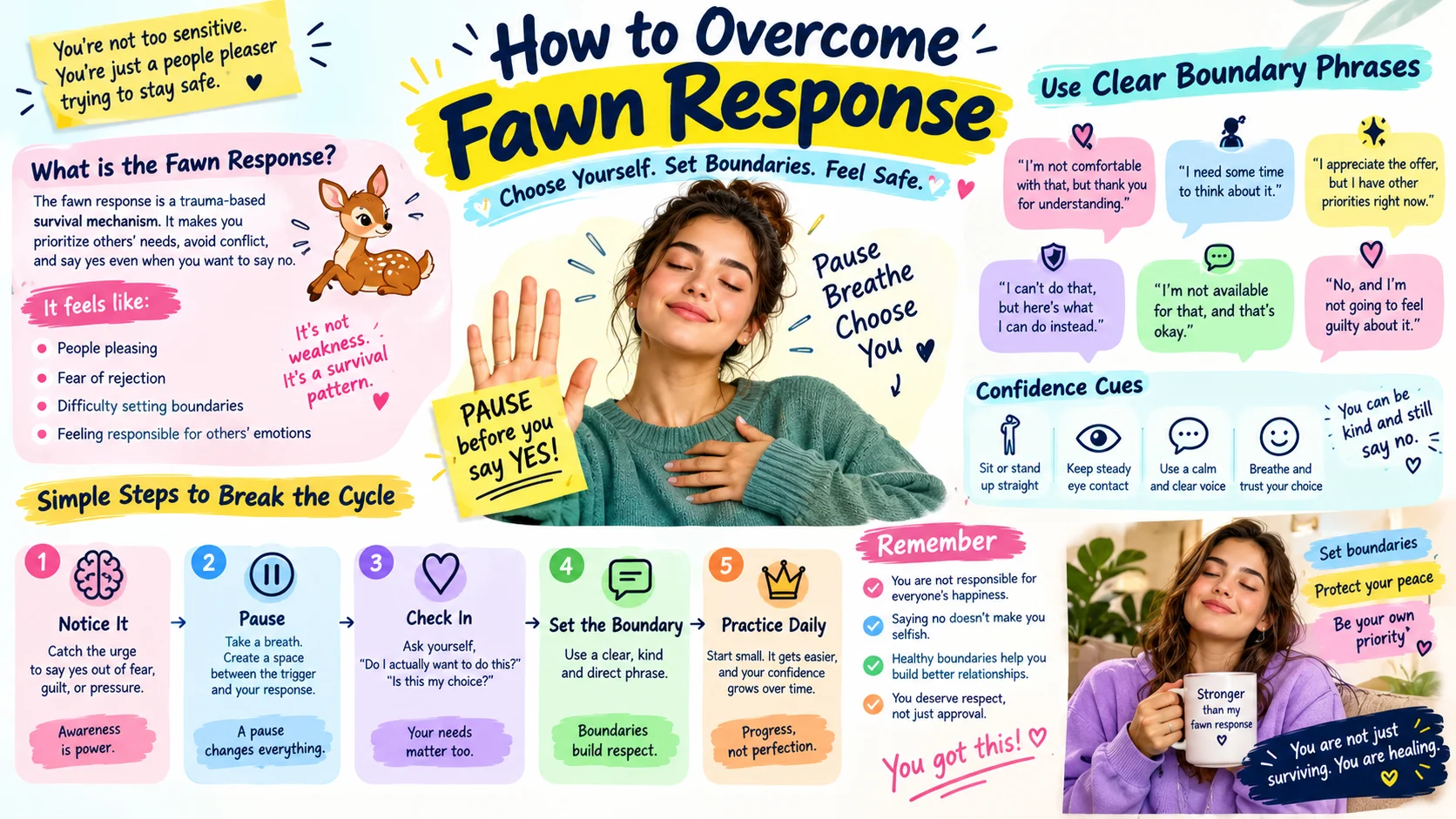
To overcome a fawn response, practice pausing before automatically pleasing others, identify what you actually want, use simple boundaries, and tolerate small amounts of discomfort without immediately fixing everyone’s feelings. Start with phrases that buy you time and protect your needs.
Top alternatives: “Let me think about it,” “I’m not available for that,” “I need some time,” “That doesn’t work for me,” “I appreciate you asking.”
The goal is not to become cold or uncaring. It is to become more comfortable being honest, setting boundaries, and choosing your response instead of automatically trying to keep everyone happy.
Ever said “sure!” while your brain was screaming “absolutely not”? Maybe you agreed to plans you did not want, apologized when you had done nothing wrong, answered a message instantly because you feared upsetting someone, or smiled through an uncomfortable situation just to keep things peaceful. If that sounds familiar, learning how to overcome fawn response can make everyday conversations feel much easier.
The fawn response often shows up as automatic people-pleasing, over-explaining, conflict avoidance, excessive apologizing, or constantly checking whether everyone else is okay. It can appear in texts, DMs, friendships, dating, family situations, school, and work.
The good news is that you do not need a personality makeover. You can start small. A pause, a boundary, or one honest sentence can create space between what someone asks and how you respond.
Calm Responses
“Let me think about that first.”
Use this when someone asks for an immediate favor and you feel pressured to say yes.
Meaning: You are giving yourself permission to pause before agreeing.
“I’ll get back to you.”
Use this when a request catches you off guard.
Meaning: You do not have to make every decision on the spot.
“I need a little time to decide.”
Use this when you notice yourself preparing an automatic yes.
Meaning: Your decision deserves consideration.
“I’m going to check my schedule first.”
Use this when someone asks you to commit before you know whether you have time.
Meaning: You are checking your actual availability instead of people-pleasing.
“I need to think about what works for me.”
Use this when another person’s preference is dominating the conversation.
Meaning: Your needs belong in the decision too.
“I’m not ready to answer yet.”
Use this when you feel emotionally rushed.
Meaning: You are allowed to take time before responding.
“Can I get back to you tomorrow?”
Use this when an answer requires more thought than you can give right now.
Meaning: You are creating healthy space instead of reacting automatically.
“I hear you. Let me think.”
Use this when you want to acknowledge someone without immediately agreeing.
Meaning: Listening does not equal agreeing.
“I want to answer honestly, so give me a minute.”
Use this when you feel tempted to say whatever keeps the peace.
Meaning: You are prioritizing honesty over automatic approval.
“I’m going to pause before I decide.”
Use this when you recognize an old people-pleasing habit kicking in.
Meaning: You are consciously interrupting the automatic response.
“I need a moment to check in with myself.”
Use this when you are unsure what you actually want.
Meaning: Your internal reaction deserves attention.
“I’ll let you know once I’ve decided.”
Use this when someone expects an immediate commitment.
Meaning: You control the timing of your answer.
Confident Responses
“No, I can’t do that.”
Use this when you know a request crosses your limits.
Meaning: You can decline without building a courtroom case for your decision.
“That doesn’t work for me.”
Use this when a plan or request conflicts with your needs.
Meaning: A simple boundary can stand on its own.
“I’m not comfortable with that.”
Use this when something feels wrong or crosses a personal line.
Meaning: Your discomfort is useful information.
“I’ve decided not to.”
Use this when you have already made your choice.
Meaning: Your decision does not require someone else’s approval.
“I’m going to pass.”
Use this when you want a short, confident refusal.
Meaning: You can decline without sounding hostile.
“I can’t commit to that.”
Use this when you are unsure whether you can follow through.
Meaning: You are avoiding promises made from pressure.
“That’s not something I want to do.”
Use this when you need to be direct about your preference.
Meaning: Wanting something different is valid.
“I’m choosing something else this time.”
Use this when you want to reject a suggestion without creating unnecessary tension.
Meaning: Different choices do not require dramatic explanations.
“I understand your point, but I disagree.”
Use this during a disagreement when you feel tempted to instantly back down.
Meaning: Disagreement can exist without personal rejection.
“I appreciate the suggestion, but I’ll decide for myself.”
Use this when someone is pushing their preference onto you.
Meaning: Advice can be heard without automatically being followed.
“I know you may not agree, but this is my decision.”
Use this when you anticipate disappointment from someone else.
Meaning: Their reaction does not automatically change your choice.
“I’m comfortable with my answer.”
Use this when someone keeps asking you to reconsider a reasonable boundary.
Meaning: You do not have to keep negotiating once you have answered.
Gentle Boundary Responses
“I care about you, but I can’t take this on right now.”
Use this when someone needs support but you have reached your limit.
Meaning: Caring and having boundaries can coexist.
“I’d rather not discuss that.”
Use this when someone asks about something personal.
Meaning: Privacy is a legitimate boundary.
“I can listen, but I can’t solve this for you.”
Use this when you feel responsible for fixing someone’s problem.
Meaning: Support does not require taking ownership of another person’s situation.
“I’m happy to help for a little while.”
Use this when you want to help without becoming completely responsible.
Meaning: Help can have limits.
“I need some space tonight.”
Use this when you are emotionally overloaded.
Meaning: Taking space is not the same as rejecting someone.
“I’m not available to talk about this right now.”
Use this during an emotionally intense conversation.
Meaning: Timing matters, and you can choose when to engage.
“Please don’t speak to me that way.”
Use this when someone crosses a respectful communication boundary.
Meaning: You can request basic respect directly.
“I’m willing to discuss it when we can both be respectful.”
Use this when a conversation becomes hostile.
Meaning: You can pause an unhealthy interaction without abandoning the issue.
“I can help with this part, but not the whole thing.”
Use this when someone asks for more than you can reasonably provide.
Meaning: Partial support is still support.
“I understand that you’re disappointed.”
Use this when someone reacts negatively to your boundary.
Meaning: You can acknowledge their feelings without taking responsibility for them.
“I’m not changing my answer because you’re upset.”
Use this when guilt starts pulling you back into people-pleasing.
Meaning: Someone’s disappointment does not automatically make your boundary wrong.
“I want to keep this respectful.”
Use this when you need to reset the tone of a difficult interaction.
Meaning: You are protecting the quality of the conversation.
Funny Responses
“My automatic yes button is currently under maintenance.”
Use this when you catch yourself about to agree too quickly.
Meaning: Humor helps you notice an old people-pleasing pattern without shaming yourself.
“Let me consult the committee in my head.”
Use this when someone wants an instant answer.
Meaning: You are buying yourself time in a playful way.
“I almost said yes before my brain clocked in.”
Use this when you notice an automatic agreement.
Meaning: You are becoming aware of your reflex before acting on it.
“Plot twist: I actually need to think about it.”
Use this when you normally agree immediately.
Meaning: You are making space for your real preference.
“Breaking news: I have a boundary.”
Use this when you want to make a small boundary feel less intimidating.
Meaning: You are practicing directness without taking yourself too seriously.
“My people-pleasing subscription has been canceled.”
Use this when joking with a trusted friend about changing your habits.
Meaning: You are choosing healthier responses instead of automatic approval.
“Please allow three to five business minutes for my honest answer.”
Use this when you need time before responding.
Meaning: You are making a pause feel normal instead of awkward.
“I would like to speak with my internal legal team first.”
Use this when someone wants an immediate commitment.
Meaning: You are humorously protecting your decision-making space.
“My nervous system would like a rain check.”
Use this when you need to step away from an overwhelming request.
Meaning: You are recognizing that you need space before responding.
“I’m resisting the urge to say yes just to make this easy.”
Use this with someone you trust when practicing honesty.
Meaning: You are naming the people-pleasing impulse instead of obeying it.
“Today’s episode is called: I Actually Have a Preference.”
Use this when you finally state what you want.
Meaning: You are turning self-advocacy into something lighter.
“Unexpected character development: I said no.”
Use this after successfully holding a small boundary.
Meaning: You are celebrating progress without treating boundaries as something scary.
Polite Responses
“Thank you for asking, but I’m going to decline.”
Use this when you want to refuse while staying courteous.
Meaning: Politeness and boundaries can exist together.
“I appreciate the invitation, but I won’t be able to join.”
Use this when declining plans.
Meaning: You can say no without inventing an elaborate excuse.
“Thanks for thinking of me, but I’ll pass this time.”
Use this when someone includes you in a plan you do not want.
Meaning: You can appreciate the gesture without accepting it.
“I understand, but I’m not able to help with that.”
Use this when someone requests your time or energy.
Meaning: Understanding someone does not obligate you to help.
“I appreciate your perspective, although I see it differently.”
Use this during a disagreement.
Meaning: You can disagree while remaining respectful.
“Thank you for understanding.”
Use this after clearly communicating a boundary.
Meaning: You are ending the discussion without over-explaining.
“I’m grateful you asked, but that won’t work for me.”
Use this when declining a request from someone you value.
Meaning: Appreciation does not require agreement.
“I’ll have to say no this time.”
Use this when you want a gentle but definite refusal.
Meaning: A respectful no is still a complete answer.
“I’m sorry, but I’m unavailable.”
Use this when you genuinely cannot participate.
Meaning: You can give a simple reason without writing an essay.
“That sounds meaningful, but I’m going to sit this one out.”
Use this when you want to decline without criticizing the activity.
Meaning: Someone else’s interest does not have to become yours.
“I hope you understand that I need to prioritize something else.”
Use this when another commitment matters more to you right now.
Meaning: Priorities naturally change from situation to situation.
“Thank you for respecting my decision.”
Use this when someone accepts your boundary.
Meaning: You are reinforcing respectful communication.
Professional Responses
“I’ll review this and get back to you.”
Use this when a coworker asks for an immediate commitment.
Meaning: You are replacing automatic agreement with thoughtful consideration.
“I’m currently at capacity.”
Use this when another task would overload your workload.
Meaning: You can communicate limits without apologizing excessively.
“I can complete this by Friday, but not today.”
Use this when someone requests an unrealistic deadline.
Meaning: You are offering a realistic alternative instead of automatically accepting pressure.
“Which priority should I move if this needs to come first?”
Use this when someone adds work to an already full schedule.
Meaning: You are making workload tradeoffs visible.
“I’d like to clarify the expectations before I commit.”
Use this when instructions are unclear.
Meaning: Asking questions is not a failure to cooperate.
“I’m not able to take that on right now.”
Use this when your current workload is already full.
Meaning: Professional boundaries protect your ability to deliver quality work.
“I can help with one part of this.”
Use this when you can contribute but cannot own the entire task.
Meaning: You can offer realistic support without overcommitting.
“I disagree with that approach, and here’s why.”
Use this when you have a professional concern.
Meaning: Respectful disagreement can be useful at work.
“I need more information before I can give you an answer.”
Use this when someone expects certainty without enough context.
Meaning: Accuracy is more valuable than an automatic response.
“I’d prefer to discuss this privately.”
Use this when a sensitive workplace conversation happens publicly.
Meaning: You are setting a communication boundary professionally.
“I can meet that deadline if we reduce the scope.”
Use this when time and expectations conflict.
Meaning: You are proposing a practical solution instead of silently absorbing pressure.
“I want to make sure I’m giving you an honest answer rather than agreeing too quickly.”
Use this when you need time during an important workplace discussion.
Meaning: Thoughtful communication can be more professional than instant agreement.
Chill And Casual Responses
“Let me see how I feel about it.”
Use this when you are unsure about making plans.
Meaning: You are checking your actual preference.
“I might sit this one out.”
Use this when you do not want to attend something.
Meaning: You can decline casually without making it dramatic.
“I’m gonna pass this time.”
Use this when you want a relaxed no.
Meaning: A casual boundary can still be clear.
“Not feeling it today.”
Use this when you need downtime.
Meaning: You do not always need a serious explanation.
“Maybe another time.”
Use this when you genuinely want to keep the possibility open.
Meaning: You are declining the current plan without making a permanent statement.
“I’m good, but thanks.”
Use this when someone offers something you do not need.
Meaning: You can reject an offer without rejecting the person.
“I’ll think about it.”
Use this when you want to avoid an instant yes.
Meaning: You are giving yourself breathing room.
“I’m keeping tonight low-key.”
Use this when you want personal downtime.
Meaning: Rest and solitude are legitimate choices.
“I’d rather do something else.”
Use this when you have a different preference.
Meaning: You are practicing expressing what you actually want.
“I’m not up for that.”
Use this when your energy or interest is low.
Meaning: Your current capacity matters.
“I’m gonna take a rain check.”
Use this when you want to postpone plans.
Meaning: You can protect your time without making the situation awkward.
“I’ll let you know.”
Use this when you genuinely need more time before deciding.
Meaning: You are avoiding a pressured commitment.
Sweet Responses
“I care about you, but I need to take care of myself too.”
Use this when you feel guilty for prioritizing your own needs.
Meaning: Self-care does not cancel out care for others.
“I hope you know this isn’t personal.”
Use this when declining something from someone you care about.
Meaning: A boundary does not automatically mean rejection.
“You matter to me, and so do my limits.”
Use this when explaining a boundary to someone important.
Meaning: Healthy relationships can hold both affection and boundaries.
“I’m still here, I just need some space.”
Use this when you need temporary distance.
Meaning: Space can coexist with connection.
“I appreciate you hearing me.”
Use this after expressing a difficult need.
Meaning: You are encouraging respectful communication.
“I want to be honest because I value our relationship.”
Use this when honesty feels uncomfortable.
Meaning: Directness can come from care rather than conflict.
“I’m not upset with you. I just need something different.”
Use this when your preference differs from someone else’s.
Meaning: Difference does not automatically mean anger.
“Thank you for giving me room to decide.”
Use this when someone respects your pause.
Meaning: You are recognizing healthy interaction.
“I care, but I can’t carry everything for everyone.”
Use this when you feel responsible for another person’s emotions.
Meaning: Compassion has limits.
“I want to help, but I need to protect my energy too.”
Use this when you need to limit how much support you provide.
Meaning: Sustainable kindness includes self-protection.
“I hope you can respect where I’m coming from.”
Use this when communicating a personal boundary.
Meaning: You are asking for understanding without demanding agreement.
“I’m learning to be honest about what I need.”
Use this when explaining a new boundary.
Meaning: You are framing personal growth as an ongoing process.
Clever Responses
“Let me separate what I want from what I think you want.”
Use this when you notice yourself prioritizing another person automatically.
Meaning: You are checking whether your decision is genuinely yours.
“I need to answer the question, not manage the reaction.”
Use this when you fear someone will dislike your answer.
Meaning: Your job is to communicate honestly, not control another person’s feelings.
“Their disappointment does not automatically mean I did something wrong.”
Use this when guilt appears after setting a boundary.
Meaning: Another person’s reaction is not always evidence that your choice was harmful.
“I can be kind without being constantly available.”
Use this when you feel pressured to respond immediately.
Meaning: Kindness does not require unlimited access to you.
“A pause is a response too.”
Use this when you feel compelled to answer instantly.
Meaning: Silence or time can prevent an automatic people-pleasing reaction.
“I can disappoint someone without betraying myself.”
Use this when a reasonable boundary creates guilt.
Meaning: Temporary disappointment can be easier to tolerate than chronic self-abandonment.
“I don’t need a perfect reason to have a preference.”
Use this when you feel tempted to justify every choice.
Meaning: Preferences do not always require evidence.
“No explanation marathon today.”
Use this when you notice yourself over-explaining a simple no.
Meaning: You are practicing concise communication.
“My comfort belongs in the equation.”
Use this when you are considering everyone else but yourself.
Meaning: Your needs are relevant to decisions that affect you.
“I can listen without absorbing everything.”
Use this when someone shares intense emotions with you.
Meaning: Empathy does not require taking ownership of another person’s feelings.
“I can change my mind without making it a crisis.”
Use this when you realize you agreed to something you no longer want.
Meaning: Changing your decision can be a normal part of honest communication.
“Being agreeable and being authentic are not the same thing.”
Use this when you are reflecting on automatic people-pleasing.
Meaning: Authenticity sometimes requires a respectful disagreement.
Emotional Responses
“I’m scared of disappointing you, but I still need to be honest.”
Use this when fear makes it difficult to state your real preference.
Meaning: You are choosing honesty while acknowledging the discomfort.
“I feel guilty saying no, but guilt doesn’t mean no is wrong.”
Using this when setting a reasonable boundary feels emotionally uncomfortable.
Meaning: An uncomfortable emotion does not automatically invalidate your decision.
“I need to stop apologizing for having needs.”
Use this when you notice yourself saying sorry for normal requests.
Meaning: Having needs is not inherently a problem.
“I’m allowed to take care of myself without earning it first.”
Use this when you feel you must exhaust yourself before resting.
Meaning: Rest and self-care do not need to be rewards.
“I want to be honest even if honesty feels uncomfortable.”
Using this when avoiding conflict feels easier.
Meaning: Discomfort can accompany healthy communication.
“I’m noticing that I’m trying to keep everyone happy.”
Use this when you recognize a familiar pattern.
Meaning: Awareness is the first step toward choosing a different response.
“I don’t know what I want yet, and that’s okay.”
Use this when you feel pressured to have an immediate answer.
Meaning: Uncertainty is a valid temporary state.
“I can feel anxious and still set a boundary.”
Use this when nervousness makes you want to back down.
Meaning: Confidence does not require feeling completely calm.
“I’m allowed to have mixed feelings.”
Use this when you both care about someone and need distance.
Meaning: Conflicting emotions can coexist.
“I’m learning that peace does not always mean avoiding disagreement.”
Use this when you normally suppress your opinion to prevent tension.
Meaning: Honest communication can be healthier than automatic silence.
“I don’t have to fix every uncomfortable moment.”
Use this when someone becomes disappointed after you say no.
Meaning: You can allow a moment of discomfort without immediately repairing it.
“I’m choosing honesty over automatic approval.”
Use this when you are deliberately breaking a people-pleasing habit.
Meaning: You are making authenticity the priority.
Supportive Responses
“What do I actually want right now?”
Use this when you notice yourself automatically following another person’s preference.
Meaning: You are reconnecting with your own needs.
“Is this a genuine yes or a fearful yes?”
Use this when agreement feels automatic.
Meaning: You are distinguishing authentic willingness from pressure.
“Would I still agree if I knew they would be completely okay with no?”
Use this when fear of disappointing someone is driving your decision.
Meaning: You are checking whether fear is influencing your choice.
“I can give myself permission to pause.”
Use this when you feel rushed to answer.
Meaning: A pause creates room for conscious decision-making.
“My first instinct does not have to be my final answer.”
Use this when you automatically say yes.
Meaning: You can reconsider an immediate reaction.
“I can practice with small boundaries.”
Use this when larger confrontations feel overwhelming.
Meaning: Everyday situations can become practice for stronger self-advocacy.
“I can start with one honest sentence.”
Use this when you tend to over-explain.
Meaning: Clear communication does not have to be complicated.
“I don’t need everyone to approve of me.”
Use this when approval-seeking becomes overwhelming.
Meaning: Self-worth does not depend entirely on universal approval.
“I can be responsible for my behavior without managing everyone’s emotions.”
Use this when you feel guilty about someone else’s reaction.
Meaning: Accountability and emotional responsibility are not identical.
“I can ask for what I need.”
Use this when you usually expect yourself to adapt silently.
Meaning: Needs can be communicated rather than hidden.
“I can survive a little awkwardness.”
Use this when a boundary feels socially uncomfortable.
Meaning: Temporary awkwardness is often manageable.
“I’m allowed to choose myself sometimes.”
Use this when you feel selfish for prioritizing your needs.
Meaning: Self-prioritization is not automatically selfishness.
Self-Respect Responses
“My needs deserve a place at the table.”
Use this when everyone else’s preferences are dominating a decision.
Meaning: Your needs deserve consideration too.
“I don’t owe everyone unlimited access to me.”
Use this when someone expects constant availability.
Meaning: Access to your time and energy can have boundaries.
“I can say no without becoming a bad person.”
Use this when guilt appears after refusing something reasonable.
Meaning: A boundary does not define your character.
“I deserve relationships where honesty is allowed.”
Use this when you fear that disagreement will cost you connection.
Meaning: Healthy connection can make room for different opinions.
“I don’t need permission to have limits.”
Use this when you feel you need someone else to approve your boundary.
Meaning: Personal boundaries do not require unanimous agreement.
“I can respect myself and still respect them.”
Use this during a disagreement.
Meaning: Self-respect does not require disrespecting another person.
“I am allowed to leave conversations that become disrespectful.”
Use this when communication stops being constructive.
Meaning: Ending an unhealthy interaction can be a legitimate boundary.
“My time is valuable too.”
Use this when you constantly rearrange your schedule for others.
Meaning: Your time deserves consideration.
“I can care without overextending myself.”
Use this when kindness becomes exhausting.
Meaning: Sustainable support includes personal limits.
“I can disagree without attacking.”
Use this when you are afraid that disagreement will automatically become conflict.
Meaning: Assertiveness can remain respectful.
“I don’t have to shrink to make someone comfortable.”
Use this when you are tempted to silence your needs.
Meaning: You can take up appropriate emotional and conversational space.
“My boundary is not an insult.”
Use this when you worry that saying no will hurt someone.
Meaning: A personal limit is not automatically a personal attack.
Dating And Friendship Responses
“I like you, but I still need my own space.”
Use this when dating or friendship starts feeling overly demanding.
Meaning: Affection and independence can coexist.
“I’d love to see you, but tonight doesn’t work.”
Use this when you want connection but cannot make the proposed plan.
Meaning: Declining a plan does not mean declining the relationship.
“I actually have a different preference.”
Use this when you usually let the other person choose everything.
Meaning: Sharing preferences creates more balanced relationships.
“I’m interested, but I want to take things slowly.”
Use this when you feel pressured to move faster than you want.
Meaning: Interest does not require immediate commitment.
“I need some time to myself.”
Use this when socializing becomes overwhelming.
Meaning: Solitude can be part of maintaining balance.
“I don’t want to pretend I’m okay when I’m not.”
Use this when you usually hide discomfort from a friend or partner.
Meaning: Honest communication can prevent resentment.
“I care about you, but I disagree.”
Use this when a friendship disagreement makes you afraid of rejection.
Meaning: Connection can survive different opinions.
“I’m not comfortable with that joke.”
Use this when someone crosses a personal line.
Meaning: You can name discomfort without creating a dramatic confrontation.
“I’d rather talk about this when we’re both calmer.”
Use this during an emotionally intense disagreement.
Meaning: Timing can improve communication.
“I want to tell you what I actually think.”
Use this when you notice yourself agreeing simply to avoid tension.
Meaning: You are choosing authenticity.
“I don’t want to agree just because I’m afraid you’ll be upset.”
Use this when pressure is influencing your answer.
Meaning: Fear should not make every decision for you.
“I’m still figuring out what feels right for me.”
Use this when you are uncertain about a relationship decision.
Meaning: You can communicate uncertainty honestly instead of pretending to know.
Assertive Responses
“No, thank you.”
Use this when a simple refusal is enough.
Meaning: A short answer can be both firm and respectful.
“I disagree.”
Use this when you genuinely hold a different opinion.
Meaning: You can state disagreement without launching into an argument.
“I need you to stop.”
Use this when someone continues a behavior after you have expressed discomfort.
Meaning: You are clearly communicating a boundary.
“That doesn’t feel okay to me.”
Use this when you need to identify a personal limit.
Meaning: Your experience matters in the interaction.
“I’m not going to explain this again.”
Use this when someone repeatedly challenges a clearly stated boundary.
Meaning: You do not have to endlessly defend a decision.
“I’ve answered the question.”
Use this when someone keeps pushing for a different response.
Meaning: Repetition does not create an obligation to change your answer.
“I need you to respect my decision.”
Use this when another person refuses to accept your boundary.
Meaning: Respect includes allowing people to make their own choices.
“I’m willing to talk, but not like this.”
Use this when a disagreement becomes disrespectful.
Meaning: You are willing to communicate under healthier conditions.
“I can hear your opinion without changing mine.”
Use this when someone repeatedly tries to persuade you.
Meaning: Listening does not require surrendering your position.
“I’m not available for that conversation.”
Use this when you need to disengage from a topic.
Meaning: You can choose what conversations you participate in.
“I need some distance right now.”
Use this when an interaction feels overwhelming.
Meaning: Temporary distance can create emotional breathing room.
“I’m going to leave this conversation for now.”
Using this when continuing would likely make things worse.
Meaning: Ending an interaction can be a deliberate boundary rather than avoidance.
Healing-Focused Responses
“I’m noticing the urge to please everyone.”
Use this when an old automatic reaction appears.
Meaning: Naming the pattern can help you create space before acting.
“I don’t have to fix this immediately.”
Use this when someone else is uncomfortable or upset.
Meaning: You can allow emotions to exist without rushing to repair them.
“I can tolerate this moment without abandoning myself.”
Use this when a boundary creates anxiety.
Meaning: Discomfort can be experienced without automatically giving up your needs.
“I’m learning that saying no is allowed.”
Use this when you are practicing your first boundaries.
Meaning: Permission to decline can become more familiar with practice.
“I can make a different choice this time.”
Use this when you notice an old people-pleasing pattern.
Meaning: Past habits do not dictate every future response.
“I can apologize when I’m wrong, not just when someone is unhappy.”
Use this when you apologize automatically.
Meaning: Apologies can be meaningful instead of reflexive.
“I’m allowed to notice resentment before it gets huge.”
Using this when constantly helping others leaves you frustrated.
Meaning: Resentment can signal that your boundaries need attention.
“I can ask for help instead of handling everything alone.”
Use this when you feel responsible for everything.
Meaning: Receiving support can be part of healthier relationships.
“I can choose honesty even when approval feels tempting.”
Use this when you want to agree for validation.
Meaning: Authenticity can become more important than immediate approval.
“I don’t need to earn my place by being useful.”
Use this when you feel valuable only when helping others.
Meaning: Your worth does not need to depend on constant service.
“I can care about someone without rescuing them.”
Use this when you feel responsible for solving another person’s problems.
Meaning: Compassion does not require taking control.
“Progress can look like one honest no.”
Use this when you feel discouraged by slow change.
Meaning: Small moments of self-advocacy can represent meaningful progress.
Boundary Practice Responses
“I can’t make that commitment right now.”
Use this when you are practicing saying no to future obligations.
Meaning: You can protect future time instead of automatically giving it away.
“I need more notice next time.”
Use this when someone repeatedly makes last-minute requests.
Meaning: You are communicating a practical limit.
“Please ask me before making plans for me.”
Use this when someone assumes your availability.
Meaning: Your time should be discussed rather than presumed.
“I’m not comfortable lending that.”
Use this when someone asks to borrow something you do not want to lend.
Meaning: Ownership includes the right to say no.
“I can’t discuss this while I’m working.”
Use this when someone interrupts your responsibilities.
Meaning: Your attention has limits.
“I’m not going to take responsibility for that.”
Use this when someone tries to shift their responsibility onto you.
Meaning: You can distinguish your responsibilities from theirs.
“I can help after I finish my current priority.”
Use this when you want to help but cannot do so immediately.
Meaning: Helping does not require abandoning existing commitments.
“I need this conversation to stay respectful.”
Use this when someone becomes dismissive or insulting.
Meaning: Respect is part of the boundary.
“I’m not comfortable sharing that information.”
Use this when someone asks for personal details.
Meaning: You can protect your privacy without feeling guilty.
“I’ll decide when I’m ready.”
Use this when someone pressures you to make a choice.
Meaning: Your timeline matters.
“I appreciate the concern, but I can handle this.”
Use this when someone becomes overly involved in your decision.
Meaning: You can acknowledge care while maintaining independence.
“That request is more than I can reasonably take on.”
Use this when someone asks for too much.
Meaning: Recognizing capacity is a practical form of self-respect.
FAQs
What Does The Fawn Response Mean?
The fawn response generally describes a pattern of trying to keep others happy, avoid conflict, gain safety, or reduce tension by automatically accommodating them. It can look like excessive people-pleasing, apologizing, agreeing, or ignoring your own needs.
How Can You Start Overcoming A Fawn Response?
Start with small pauses. Instead of immediately saying yes, try “Let me think about it.” Then check what you actually want, what you can realistically handle, and whether fear of someone’s reaction is influencing your answer.
Is The Fawn Response The Same As Being Kind?
No. Kindness is a choice to treat people with care. A fawn response can involve automatically prioritizing another person’s needs while ignoring your own. Healthy kindness can include boundaries, honesty, and saying no.
Can The Fawn Response Affect Dating And Friendships?
It can show up in relationships through constant agreement, difficulty expressing preferences, excessive apologizing, or fear of disappointing someone. Practicing small honest statements can help create more balanced communication.
Is It Okay To Use Humor When Setting A Boundary?
Yes, when the situation is safe and the other person understands the joke. Humor can make small boundaries feel less intimidating. However, serious boundaries may need clear, direct language rather than jokes.
What If I Say Yes And Regret It Later?
You can correct yourself. Try saying, “I thought about it, and I need to change my answer.” Changing your mind is allowed, especially when you realize that your original response came from pressure rather than genuine willingness.
Should I Explain Every Boundary?
No. A brief explanation can be useful when appropriate, but you do not need to provide a detailed defense for every reasonable boundary. “That doesn’t work for me” can be enough.
What If Someone Gets Upset When I Say No?
Their disappointment may be uncomfortable, but you are not automatically responsible for removing it. You can acknowledge their feelings while maintaining your decision.
Can You Overcome A Fawn Response Completely?
People can learn healthier ways to respond to pressure, conflict, and requests. Progress may involve noticing automatic reactions earlier, practicing boundaries, and becoming more comfortable with honest communication. If these patterns are deeply distressing or connected to past experiences, a qualified mental health professional can provide individualized support.
What Is A Good First Phrase To Practice?
“Let me think about it” is a useful starting point because it creates a pause without requiring an immediate confrontation. Once you have space, you can decide whether your genuine answer is yes, no, or something in between.
Conclusion
Learning how to overcome fawn response is not about becoming cold, selfish, or impossible to please. It is about creating enough space to hear your own answer before automatically giving someone else the answer they seem to want.
Start tiny. Pause before saying yes. Replace unnecessary apologies with clear statements. Practice saying what you prefer. Let a little awkwardness exist without rushing to fix it.
The perfect response is not always the cleverest one. Sometimes it is simply, “That doesn’t work for me.” Every honest boundary gives you another chance to communicate with confidence.
Save this list for the next time your people-pleasing autopilot tries to take the wheel. Share it with someone who needs a reminder that their needs matter too.